Prohibition
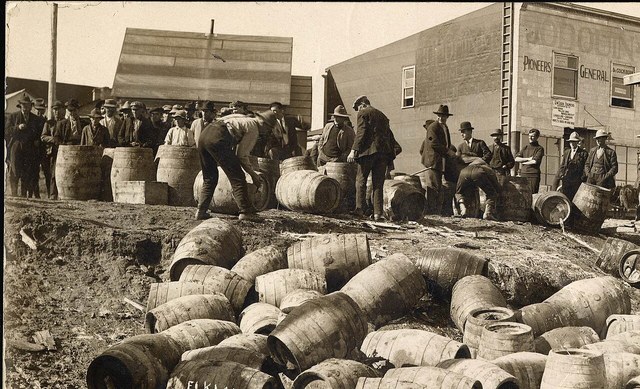
U.S. alcohol ban · 1920–1933 · United States
Prohibition was the nationwide ban on alcohol sale and transport enacted by the Eighteenth Amendment and enforced by the Volstead Act.
The kit
- Rise — Prohibition was promoted by the Woman's Christian Temperance Union led by Frances Willard and the Anti-Saloon League led by Wayne Wheeler.
- Achievements — Prohibition became law when the Volstead Act was enacted in 1920 to carry out the Eighteenth Amendment's alcohol ban.
- Conflicts — Prohibition was widely circumvented through speakeasies and bootleggers, while the Purple Gang thrived and committed the St. Valentine's Day Massacre.
- Legacy — Prohibition ended in 1933 when the Twenty-first Amendment repealed the Eighteenth Amendment after the Cullen-Harrison Act liberalized the policy.
Runs with
Volstead Act
Maine
Carrie Nation
The ladder · 15 clues
The signing of the Cullen-Harrison Act liberalized this policy, which ended later the same year.
This policy was enabled by the Volstead Act, and its promoters included the Woman's Christian Temperance Union and the Anti-Saloon League.
An early success for this cause was Neal Dow’s passing of the “Maine Law,” though that was eventually overturned by a riot in Portland.
A riot in Portland, Maine resulted from the “Maine Law” enacting this policy that was advanced by James Appleton and Neal Dow.
13-year period of American history when sale and transport of alcohol was banned by the 18th Amendment.
For supporting this movement, Rutherford B. Hayes’ wife, Lucy, received a derisive nickname.
This policy was largely ignored by Congress as senators flocked to buy from “the man in the green-hat,” George Cassiday.
This policy became law when the Volstead Act was enacted to carry out the Eighteenth Amendment. name this 1920s policy that banned liquor throughout the US.
A Christian organization within this movement was led by feminist Frances Willard and was called the WCTU.
Wayne Wheeler drafted the Volstead Act that enforced this period.
A group promoting this cause advocated for “Protection for the home” and was led by Matilda Carse and Frances Willard.
This cause, which the WCTU’s Carrie Nation helped enforce with an axe, was circumvented by the establishment of “speakeasies.” The 1920 Volstead Act was the ultimate success for this cause, but was overturned in 1933 by the 21st Amendment. name this social cause that seeks to ban intoxicating liquors.
This policy was supported by the hatchet-wielding Carrie Nation and enacted nationwide by the Volstead Act. name this policy that was repealed by the 21st amendment and banned the sale of most alcohol.
The Volstead Act allowed federal enforcement of this policy, and Speakeasies became commonplace as Americans attempted to skirt this policy. name this policy implemented via the 18th Amendment and repealed in 1933.
The Anti-Saloon League backed this policy that banned the sale of alcohol.
10 more clues from the record
The Jewish-led Purple Gang thrived during this period and were suspected of committing the St. Valentine’s Day Massacre.
Wayne Wheeler founded an organization promoting this policy, and the hatchet-wielding Carrie A. Nation promoted it violently.
To promote this cause, Howard Hyde Russell signed children up to the Lee-Lincoln Legion.
Attempts to circumvent this policy led to people developing “jake leg” syndrome.
Speakeasies began to be established during this period following the passage of the Eighteenth Amendment, during which alcohol was banned in the United States.
The so-called “Napoleon” of this movement was Neal Dow, who later fought in the Civil War, but was wounded at the siege of Port Hudson.
The Volstead Act was passed to carry out this legislation, whose passage led to a rise in speakeasies and bootleggers.
Walt Whitman’s terrible early novel Franklin Evans was circulated by a group supporting this cause called the Washingtonian Society.
A violent advocate of this cause interpreted a tornado striking Kansas as God's approval for her first-ever protests in Kiowa in 1900.
The concept of “pressure politics” was pioneered by a group supporting it whose leaders included William “Pussyfoot” Johnson.

.jpg)