Henry Clay
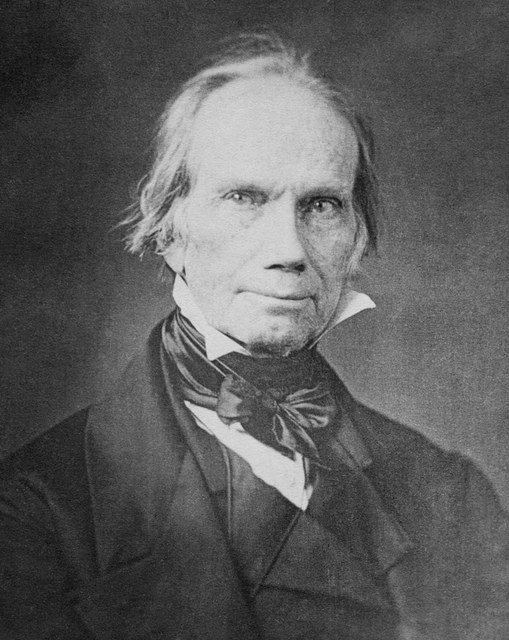
Kentucky politician · 1777–1852 · Kentucky, Washington D.C.
Henry Clay was a Kentucky politician nicknamed the 'Great Compromiser' who advocated the American System and lost multiple presidential elections.
The kit
- Rise — Henry Clay joined the War Hawks contingent in Congress advocating for the War of 1812 alongside Felix Grundy.
- Achievements — Henry Clay promoted the American System, a plan including protectionist tariffs and federal infrastructure projects like the National Road.
- Conflicts — Henry Clay was accused of a 'Corrupt Bargain' with John Quincy Adams after the 1824 election went to a House runoff.
- Legacy — Henry Clay introduced eight resolutions that became the Compromise of 1850, beginning with California statehood.
Runs with
Kentucky
Secretary of State
Compromise of 1850
John Quincy Adams
The ladder · 15 clues
After having worked on this man’s estate of Ashland, this man’s slave, Charlotte Dupuy, unsuccessfully sued for her freedom in Washington D.C..
This man advocated for high tariffs and regular infrastructure improvements as part of his American System.
This man was forced to duel Humphrey Marshall after proposing a law that banned British cloth in favor of homespun cloth.
This man was sued by his slave, Charlotte Dupuy, for her freedom, though he also helped found the colony of Liberia as president of the American Colonization Society.
This man was shot in a duel by Humphrey Marshall over this man’s support of the Embargo Act. :Name this Kentucky politician who ran for president unsuccessfully five times and was known as the Great Compromiser.
This man lost presidential elections in 1824, 1832, and 1844. :Name this Kentucky Senator known as the “Great Compromiser,” who devised the Compromise of 1850 after the Mexican War.
This proponent of the American System also introduced the Compromise of 1850. name this Kentucky Whig who served as Speaker of the House and was nicknamed “The Great Compromiser”.
In 1824, this man was appointed as Secretary of State by John Quincy Adams after the presidential election went to a House runoff.
This proponent of the "American System" of roads and canals was defeated both during Andrew Jackson's re- election bid and by James K. Polk in two presidential runs as the Whig nominee. name this "Great Compromiser" from Kentucky.
As the National Republican party’s nominee, this politician lost the 1832 presidential election to Andrew Jackson.
Andrew Jackson’s biggest presidential regret was supposedly that he didn’t hang John C. Calhoun and didn’t shoot this man.
This politician advocated for investment in infrastructure, higher tariffs, and a national bank as part of his American System.
This man was accused of striking a “corrupt bargain” with John Quincy Adams that led to him becoming Secretary of State. name this Kentucky politician labeled the “Great Compromiser.”
This proponent of the American System was accused of arranging a “Corrupt Bargain” with John Quincy Adams. name this “Great Compromiser” from Kentucky.
John Quincy Adams made an infamous “Corrupt Bargain” with this War Hawk nicknamed the “Great Compromiser” from Kentucky.
10 more clues from the record
A personal grudge against this man may have led to the veto of the Maysville Road.
Charlotte Dupuy sued this man for her freedom after being a slave at his hemp plantation at Ashland.
This politician fought a duel with John Randolph in which both escaped unscathed.
This politician wrote that the Mexican-American War would produce “some military chieftain who will conquer all of us” before his son died in the Battle of Buena Vista.
Like William Jennings Bryan, this man won a significant portion of electoral votes in multiple elections without becoming president.
This man fought an indecisive duel with John Randolph and advocated for the War of 1812 as a War Hawk.
This man promoted a plan including protectionist tariffs and federal infrastructure projects like the National Road and the Maysville Road.
Though a local rival of Felix Grundy, this man joined Grundy in the "War Hawks" contingent in Congress.
A set of eight resolutions named for this man, beginning with California statehood, were the basis for the Compromise of 1850.
This politician was the target of a freedom suit by one of his enslaved persons, Charlotte Dupuy.