Persian Gulf War
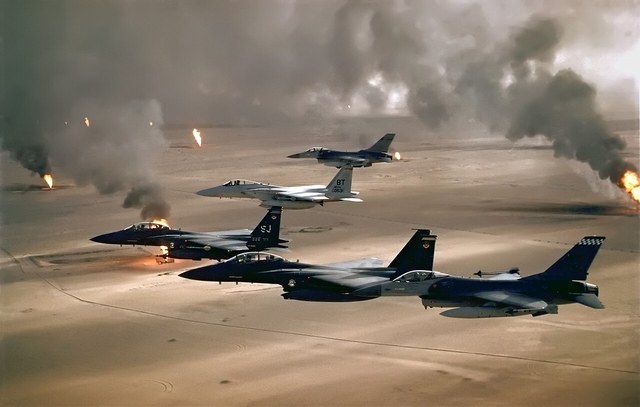
1991 U.S.-led military conflict · 1991 · Kuwait and Iraq
Persian Gulf War was the 1991 conflict in which a U.S.-led coalition expelled Iraqi forces from Kuwait through Operation Desert Storm.
The kit
- Cause — Persian Gulf War began when Iraq invaded Kuwait over disputes about the Rumaila oil field and sought to capture Jaber al-Sabah from Dasman Palace.
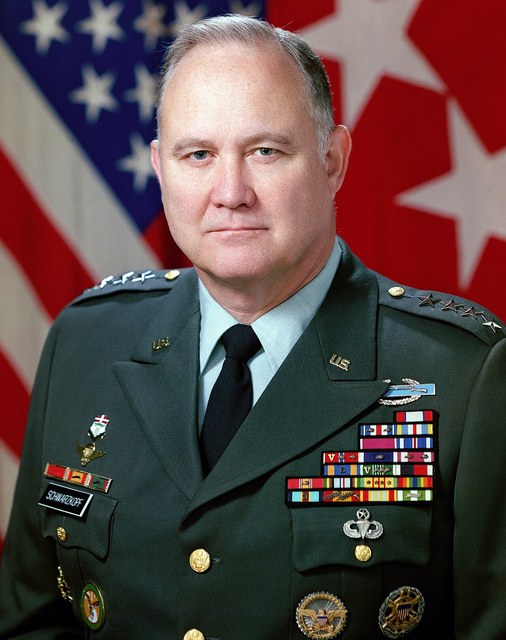
- Military operations — Persian Gulf War featured Norman Schwarzkopf commanding coalition forces to victory in less than five days of ground combat after Chuck Horner's air campaign.
- Highway of Death — Persian Gulf War saw Iraqi Republican Guard forces destroyed while retreating to Basra on Highway 80, which became known as the Highway of Death.
- Aftermath — Persian Gulf War left a legacy of Gulf War Syndrome among U.S. veterans, possibly caused by depleted uranium or Pyridostigmine Bromide exposure.
Runs with
Norman Schwarzkopf
Saddam Hussein
Iraq
The ladder · 15 clues
Jean Baudrillard [[bo-dree-YAHRD]] wrote a thesis claiming that this conflict did not take place.
This war was the subject of a controversy in which members of the 1st Mechanized Infantry Division used bulldozers to clear out fortified lines by burying enemy troops alive.
A mysterious syndrome named for this war that affected U.S. troops may have been caused by the usage of depleted uranium.
In this war, the Republican Guard was destroyed on the Highway of Death while retreating to Basra.
In this war, a Scud missile attack on the barracks at Dhahran killed 28 American soldiers.
The initial invasion of this war may have sought to capture Jaber al-Sabah from Dasman Palace, but he fled and ruled in exile from a Saudi Arabian hotel room.
Exposure to the chemical Pyridostigmine [["pie"-rih-doh-STIG-meen]] Bromide led to this war's namesake "syndrome," a debilitating chronic illness common among U.S. veterans.
The losing country’s leader promised “the mother of all battles” in this war, which featured Americans bombing a convoy on the Highway of Death.
The losing side in this war burned over 700 oil wells as it retreated.
This conflict featured the bombing of Highway 80 as the losing side retreated, leading that road to be called the Highway of Death. 700 oil wells were burnt as the losing side fell back in this conflict.
It began over disputes about the Rumaila oil field.
The invading side in this war was led by Norman Schwarzkopf, who secured victory in less than 5 days.
Operation Desert Storm was a part of this 1991 conflict started by coalition forces to expel Iraq from Kuwait.
Norman Schwarzkopf commanded American forces during this war.
Chuck Horner commanded troops in this war before the arrival of Norman Schwarzkopf. name this war in which Operation Desert Storm reacted to Saddam Hussein’s invasion of Kuwait.
10 more clues from the record
A fifteen-year-old girl named Nayirah testified that one side in this war removed babies from hospital incubators.
This war included the Battle of Khafji, and one side’s army during it was commanded by Khalid bin Sultan.
The air campaign in this conflict was led by Chuck Horner, which led to a victory at The Battle of Khafji.
During this war, the 18th Mechanized Brigade was wiped out in minutes because of a decisive assault and poor visibility conditions in the Battle of 73 Easting.
This operation was the last that the USS Missouri fought in before its retirement, and it was declared to have lasted exactly 100 hours.
An important action early in this war was the use of air strikes to drive back an attack on the city of Khafji.
A controversial moment in this war was American troops using bulldozers to bury enemy defenders alive.
The end of this war's hostilities have partially been attributed to photos released of the Highway of Death.
Senegal lost the second highest amount of combatants in a coalition during this war due to a helicopter crash.
The first major battle of this war was a failed attempt to capture and hold the city of Khafji.