The 1648 Codex · study package

US Treaties & Diplomatic Agreements

16 terms drawn from across the corpus, in study-list order. Art and cross-links point back to the home category cards.

#888 · International Treaties and Diplomatic Agreements · Level 2

Treaty of Portsmouth
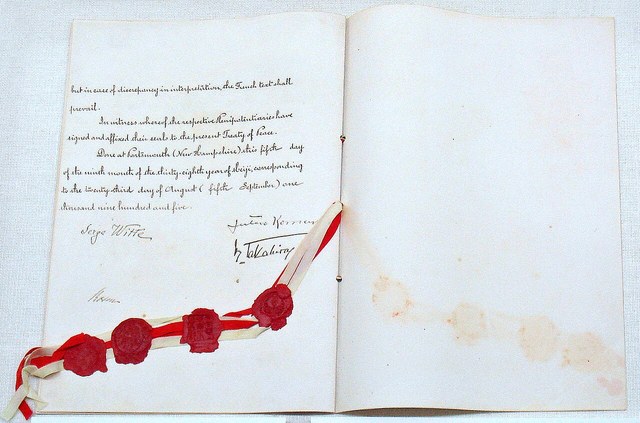
Treaty of Portsmouth
World Imaging · CC BY-SA 3.0

1905 peace treaty · 1905 · Portsmouth, New Hampshire

Treaty of Portsmouth ended the Russo-Japanese War and was mediated by Theodore Roosevelt, earning him the Nobel Peace Prize.

The kit

  • Negotiations — Treaty of Portsmouth was negotiated in Portsmouth, New Hampshire at a U.S. naval facility, with delegates including Sergei Witte and Komura Jutaro.
  • Terms — Treaty of Portsmouth awarded southern Sakhalin Island to the victorious nation and called for simultaneous evacuation of Manchuria except the Liaodong Peninsula.
  • Mediation — Treaty of Portsmouth earned Theodore Roosevelt the Nobel Peace Prize, making him the first U.S. President to receive the honor.
  • Aftermath — Treaty of Portsmouth sparked the Hibiya Riots in Tokyo, protests resulting in 17 deaths and destruction of over 300 buildings.

Runs with

Russo-Japanese War
ended this war after battles at Port Arthur open card →
Theodore Roosevelt
mediated negotiations and won Nobel Prize for brokering it open card →
Nanda Empire
Japan
victorious nation that gained southern Sakhalin open card →

The ladder · 9 clues

H

This treaty ended a war that included two battles of Port Arthur in Manchuria.

H

One side gained the Southern half of Sakhalin as the result of this treaty, which was negotiated by Theodore Roosevelt. FTPE:Name this 1905 treaty.

H

In this treaty, the Liaodong Peninsula was ceded to a side represented by Komura Jutaro, while Port Arthur and half of Sakhalin were given to a country represented by Sergei Witte.

H

As a result of this treaty, the southern half of Sakhalin [[SAH-kah-leen]] Island was awarded to the victorious nation.

H

A protest against this treaty in Hibiya Park resulted in 17 deaths and the destruction of over 300 buildings.

H

A General Stores Building was the site of the negotiations of this treaty, whose delegates included Roman Rosen.

M

Theodore Roosevelt helped broker this peace treaty, named for the American town where it was negotiated, to end the Russo-Japanese War.

M

Teddy Roosevelt helped mediate this treaty ending the war, named for the U.S. naval facility at which it was signed.

E

Negotiations for this treaty were organized by Theodore Roosevelt, earning him a Nobel Peace Prize.

7 more clues from the record
H

After this treaty was brokered, its mediator earned a Nobel Peace Prize, the first U.S. President to earn one.

H

Duringthistreaty’snegotiations,SergeiWittethreatenedtoendtheceasefireiftheothersiderefused to drop their reparation claims and accept Sakhalin Island in return.

H

Answer the following about violence in early 20th century Japan, .The 1905 Hibiya Riots in Tokyo were a series of protests against this 1905 treaty, which had recently ended the Russo-Japanese War.

H

Article III called for a simultaneous evacuation of Manchuria with the exception of the Liaodong Peninsula, which contained the cities of Talien and Port Arthur.

H

Negotiators met secretly in the Rose Garden, where Serge Witte agreed to give Manchuria to China.

H

To avoid problems with seating arrangements, no chairs were provided at the conference that produced this document.

H

Preceded by the Taft-Katsura armistice, news of it caused the Hibiya Riot.
Watch out: Taft-Katsura agreement (preceded this treaty as an armistice)
#892 · US Treaties and Diplomatic Agreements · Level 1

Treaty of Versailles

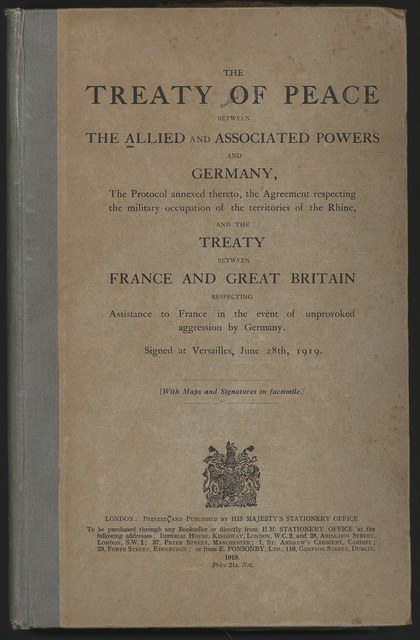
Treaty of Versailles
David Lloyd George, Woodrow Wilson and Georges Clemenceau · Public domain

1919 peace treaty · 1919 · Palace of Versailles, France

Treaty of Versailles was the 1919 peace agreement ending World War I that imposed harsh terms on Germany including territorial losses and reparations.

The kit

  • Negotiation — Treaty of Versailles was negotiated by the Big Four: Woodrow Wilson, Georges Clemenceau, David Lloyd George, and Vittorio Orlando at the Paris Peace Conference.
  • Key provisions — Treaty of Versailles included Article 231 (War Guilt Clause) requiring Germany to accept responsibility for causing World War I and pay reparations.
  • International consequences — Treaty of Versailles created the League of Nations and awarded Shandong Peninsula to Japan, sparking China's May Fourth Movement protests.
  • U.S. rejection — Treaty of Versailles was opposed by the Irreconcilables led by Henry Cabot Lodge and never ratified by the United States Senate.

Runs with

World War I
Officially ended World War I for Germany open card →
Germany
Imposed territorial losses, military restrictions, and reparations on Germany open card →
League of Nations
Established the League of Nations as part of its terms open card →
Woodrow Wilson
Negotiated by Wilson based on his Fourteen Points open card →

The ladder · 15 clues

H

The Irreconcilables opposed the signing of this treaty and were supported by Henry Cabot Lodge, who specifically opposed its Article 10.

H

The provision of this treaty that gave territory in the Shandong Peninsula to Japan sparked the Chinese nationalist movement called the May Fourth Movement.

H

Faisal delivered a speech in favor of Arab independence at the Paris Peace conference, which culminated in the signing of this Treaty ending World War I.

H

The diplomats that negotiated this treaty included Lords Sumner and Cunliffe, the “Heavenly Twins.” This treaty included global recognition of the International Opium Convention and the establishment of the Free City of Danzig.

H

A negotiator of this treaty, Edward House, was recalled from the Council of Ten for taking unsanctioned liberties.

H

This treaty was followed up in the United States by the Knox-Porter Resolution, and it was vehemently opposed by the “Irreconcilables”.

H

A requirement to join the League of Nations was the death knell of this 1919 treaty ending World War I that was never ratified by the United States.

M

Treaty that he helped negotiate at the Paris Peace Conference

M

As part of this treaty’s Article 231, Germany accepted responsibility for causing World War I. This treaty is named for the palace in which it was signed.

M

Henry Cabot Lodge led a group of Congressmen who opposed this agreement that was negotiated by the Big Four.

M

Due to its unfavorability to one side, John Maynard Keynes described this agreement as a “Carthaginian peace”.

M

One of the negotiators of this treaty joked he was “seated between Jesus Christ and Napoleon.” William Borah, Robert La Follette, and the other “Irreconcilables” were staunchly opposed to this treaty.

E

Vittorio Orlando, Georges Clemenceau, David Lloyd George, and Woodrow Wilson debated this problematic peace treaty that ended World War I for Germany.

E

Henry Cabot Lodge opposed ratification of, for the points, what treaty which officially ended World War One?

E

The League of Nations was created in response to this agreement, which built on the Fourteen Points of Woodrow Wilson. name this 1919 treaty ending the First World War.

10 more clues from the record
H

The negotiation of this treaty was walked out on by Vittorio Orlando, and its “economic consequences” were examined by John Maynard Keynes.

H

In this treaty, the Chinese had their own ambitions shot down when Shandong was given to Japan, starting protests in Tiananmen Square on May fourth.

H

The demonstrations of China’s May Fourth Movement occurred in response to a provision of it giving Shandong to Japan.

H

This treaty was modified by the Dawes and Young plans, and Italy was represented by Vittorio Orlando during its negotiation.

H

A banker and a judge who helped draft this treaty were nicknamed the “heavenly twins.” Polish pianist Ignacy Paderewski served as a delegate to this treaty, which left the status of the Teschen district unresolved and demanded the transfer of the regions of Eupen-Malmedy and Saar.

H

After changes in this treaty were made by Colonel Edward House, the president removed him and never spoke to him again.

H

This document is depicted bandaged and on crutches in a Clifford Berryman political cartoon called “The Lamb from the Slaughter.” The American Pageant author Thomas A. Bailey cast debate over this document as a “great betrayal.” A president gave speeches backing this document in the same locations as opponents like Thomas A. Reed, culminating in a near-fatal speech in Pueblo.

H

Some opponents of this agreement denounced the “November Criminals” and propagated the “Stab-in-the-back legend.” Some of this treaty’s terms were set by Lords Sumner and Cunliffe, nicknamed the “Heavenly Twins.” An ally of one party involved in this treaty was subject to the Treaty of Trianon, which was signed in a nearby palace.

H

Name some responses to World War I, :The War Guilt Clause of this peace treaty made Germany accept responsibility for all the damage caused by the war. Other sections of it governed the payment of reparations and restrictions on the German military.

H

A delegation led by the Heavenly Twins and Billy Hughes claimed that a specific clause introduced by Japan into this treaty which prohibited discrimination on the basis of race or ethnicity would destroy White Australia, so it was removed.

Watch out: Treaty of Trianon (separate treaty signed in nearby palace with Austria-Hungary's allies)
#893 · US Treaties and Diplomatic Agreements · Level 2

Louisiana Purchase

Louisiana Purchase
William Morris · CC BY-SA 4.0

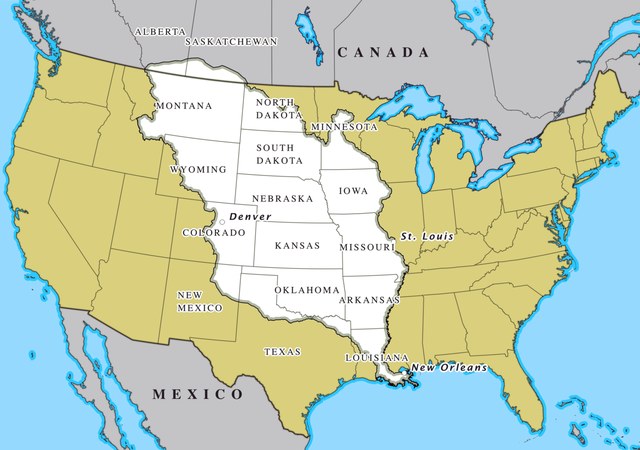
1803 U.S. land acquisition · 1803 · French territory west of Mississippi River

Louisiana Purchase was the 1803 acquisition of 800,000 square miles from France that doubled the size of the United States.

The kit

  • Negotiation — Louisiana Purchase was negotiated by Robert Livingston and James Monroe with French Treasury Minister François Barbé-Marbois for fifteen million dollars.
  • Catalyst — Louisiana Purchase became possible after the Haitian Revolution ended Napoleon's Caribbean ambitions and made him focus on European conflicts.
  • Transfer — Louisiana Purchase's official transfer occurred at Place d'Armes (Jackson Square), with Amos Stoddard serving as initial military governor before William Henry Harrison.
  • Opposition — Louisiana Purchase faced criticism from Timothy Pickering, who threatened Northern secession, and Henry Adams, who questioned Spain's Third Treaty of San Ildefonso claims.

Runs with

Thomas Jefferson
authorized the purchase as president open card →
Land
doubled U.S. territorial holdings open card →
James Monroe
negotiated the purchase with Livingston open card →
France
sold the territory under Napoleon open card →

The ladder · 9 clues

H

The U.S. president behind this agreement sent Robert Livingston and James Monroe to negotiate it.

H

An argument that this agreement was invalid claimed one side had never fulfilled the terms of the Third Treaty of San Ildefonso.

H

This deal was precipitated by a Slave Revolt in Saint-Domingue [[sahn doh- MAHNG]] and by Napoleon Bonaparte’s desire to focus on his European position.

H

The costliness of the Haitian revolution led to this sale of territory by Napoleon to the United States.

M

The Jefferson administration facilitated this "Purchase" which doubled the size of the United States.

M

One side in this agreement spent fifteen million dollars to nearly double the size of the United States.

M

François de Barbé-Marbois [bar-bay mar-bwah] was a key negotiator of this agreement, which arose after an insurrection on Saint Domingue [sahn doh-meeng].

E

The size of the United States was doubled by this 1803 purchase of French land under Thomas Jefferson.

E

Thomas Jefferson presided over this 1803 deal in which the United States acquired 800,000 square miles of land from France.

10 more clues from the record
H

Treasury Minister François Barbé-Marbois [[bar-BEH-mar-BWAH]] negotiated this agreement with James Monroe and Robert R. Livingston.

H

The official transfer of power over this territory, illustrated by Thure de Thulstrup in Harper's Weekly, took place in the Place d'Armes [], today Jackson Square.

H

Francois de Barbe-Marbois officially presented this agreement to Robert Livingston, the American negotiator of this agreement, and the Haitian Revolution reinforced this agreement’s necessity to Napoleon.

H

This agreement resulted in Amos Stoddard being appointed a military governor, a position he held until handing his lands over to William Henry Harrison.

H

This treaty was opposed by Henry Adams, who noted Spain might still have a right of reclamation despite the earlier Treaty of San Ildefonso.

H

In response to this agreement, Timothy Pickering wrote a letter to Rufus King denouncing slave states and threatening the creation of a Northern confederacy.

H

The president who authorized this agreement wrote a letter outlining his diplomatic strategy to Governor James Gerrard of Kentucky.

H

Secretary of the Treasury Albert Gallatin informed the sitting president that this acquisition was protected by the treaty-making provision in the Constitution.

H

This negotiation went ahead after the success of Toussaint L’Ouverture’s rebellion in Haiti, ending Napoleon’s hopes of a Caribbean empire.

H

John Randolph rhetorically asked about this agreement if the president realized “that no treaty is binding” until Senate approval.

Watch out: Treaty of San Ildefonso (separate agreement between France and Spain that preceded this purchase)
#894 · US Treaties and Diplomatic Agreements · Level 2

Treaty of Ghent

Treaty of Ghent
bdi Amédée Forestier /span /a · CC0

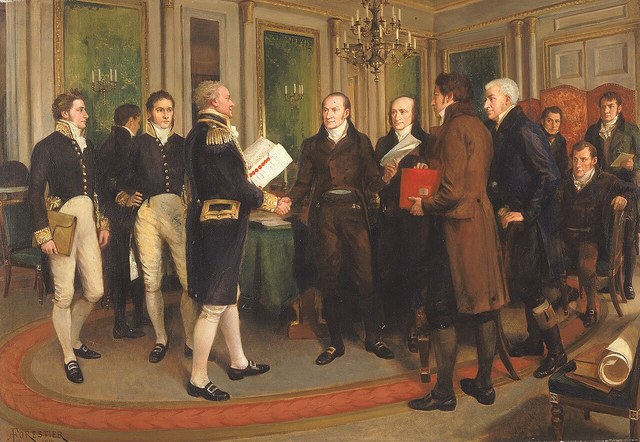
1814 peace treaty · December 24, 1814 · Ghent, Belgium

Treaty of Ghent ended the War of 1812 by restoring pre-war borders and agreements to status quo.

The kit

  • Negotiations — Treaty of Ghent was negotiated by American commissioners including Henry Clay, John Quincy Adams, and Albert Gallatin.
  • Terms — Treaty of Ghent promised to establish commissions to decide boundary disputes, dodging the issues that precipitated the war.
  • Native Americans — Treaty of Ghent's unenforced ninth article was supposed to restore land to Native Americans after British demands for a barrier state.
  • Aftermath — Treaty of Ghent was signed approximately two weeks before the Battle of New Orleans took place in January 1815.

Runs with

War of 1812
ended this conflict in 1814 open card →
Battle of New Orleans
signed two weeks before this battle open card →
Henry Clay
served on five-member negotiating team open card →
New Orleans
site of battle fought after signing open card →

The ladder · 9 clues

H

To commemorate the 100th anniversary of this treaty, Lorado Taft created a sculpture called the Fountain of Time.

H

The War of 1812 was ended in 1815 with the signing of this treaty, which generally returned most borders and agreements to the status quo from before the war.

H

One side of this treaty initially demanded the creation of an Indian barrier state in the American Northwest Territory.

H

A five member team including Albert Gallatin and Henry Clay negotiated this treaty, whose unenforced ninth article was supposed to restore land to Native Americans.

M

Weeks after the signing of this treaty, Edward Pakenham's British Regulars were defeated by Andrew Jackson at the Battle of New Orleans. name this treaty that ended the War of 1812.

M

Viscount Castlereagh [["CASTLE"-RAY]] was advised to take the pre-war status quo when negotiating this treaty across from John Quincy Adams and Henry Clay.

M

The Duke of Wellington suggested his government ask for no territorial concessions during this treaty’s negotiations.

E

This treaty was signed approximately two weeks before the Battle of New Orleans took place. identify this treaty, named for a Belgian city, that ended the War of 1812.

E

The Regency period was ruled over by George IV, who signed this treaty that ended the War of 1812.

10 more clues from the record
H

During the negotiations for this treaty, Henry Goulburn demanded the creation of a Native American buffer state in present-day Ohio.

H

The Convention of 1818 and the Rush-Bagot Treaty dealt with military controls around a border established by this treaty.

H

During negotiations for this treaty, the British launched several simultaneous invasions; one that originally marched south from Canada before being stopped at the Battle of Plattsburg and another that landed and won the battle of Bladensburg prior to burning Washington DC but failed to seize Baltimore.

H

One group in this event decided against naming Bathurst head of their commission as they felt it did not need a ranking minister, while members of the other commission included Jonathan Russell and James A. Bayard.

H

Pierre Burton’s comments on this document state, “For nothing has changed; everything is as it was in the beginning [ . . . ]” One portion of this document outlined the creation of an “Indian Barrier State” in the Northwest Territory.

H

This treaty’s tenth article calls “traffic in slaves irreconcilable with the principles of humanity and justice,” and its ninth article urges the U.S. to end hostilities with the Indians and restore their land.

H

This treaty promised to set up numerous commissions to properly decide various boundary disputes, thus dodging the issues that precipitated the war it ended.

H

Another man associated with it got the nation’s first bankruptcy act passed while serving as a congressman from Delaware.

H

Yet another man associated with it took time away from his work Anglicizing the legal system of Trinidad to work on it.

H

Its provision involving the islands in Passamaquoddy Bay was administered by one of its signers, John Holmes.

Watch out: Battle of New Orleans occurred after the treaty was signed, not before the war ended
#895 · US Treaties and Diplomatic Agreements · Level 2

Treaty of Paris

Treaty of Paris
Public domain

Peace treaty · 1763, 1783, 1856 · Paris, France

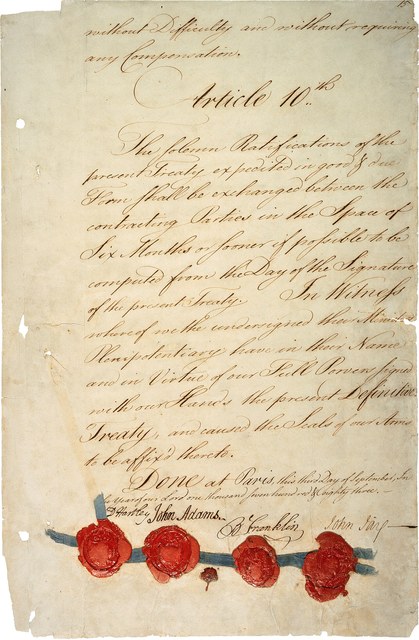
Treaty of Paris refers to multiple peace treaties signed in the French capital, most notably ending the Seven Years' War (1763) and American Revolutionary War (1783).

The kit

  • Seven Years' War — Treaty of Paris (1763) ended the Seven Years' War, transferring control of Canada from France to England and granting France St. Pierre and Miquelon.
  • Revolutionary War — Treaty of Paris (1783) formally ended the American Revolutionary War with very generous terms meant to establish trading relationships between Britain and the United States.
  • Negotiators — Treaty of Paris (1783) was negotiated by Benjamin Franklin and other American commissioners, with David Hartley representing Britain and Henry Laurens also participating.
  • Unfinished painting — Treaty of Paris (1783) negotiations were depicted in an unfinished painting with a blank white spot because the British side refused to pose.

Runs with

Paris
signed in the French capital open card →
American Revolutionary War
1783 treaty formally ended this conflict open card →
John Jay
Seven Years' War
1763 treaty ended this conflict open card →

The ladder · 9 clues

H

Treaty which ended the Seven Years' War which shares its name with the treaty which ended the Revolutionary War.

H

Name some US treaties signed before 1800. :Named after the French city where it was signed, this 1783 treaty formally ended the American Revolutionary War.

H

One of the negotiators of this treaty, David Hartley, invented an iron plank called a “fire plate” that could limit the growth of fires.

H

An unfinished painting of this treaty’s negotiators has a blank white spot on the right because one side refused to pose.

M

Set up what 1783 peace treaty between Britain and the U.S.?

M

Russia lost control of Bessarabia and demilitarized the Danube and Black Sea under the terms of this 1856 treaty that concluded the Crimean War.

M

Following the fall of his ministry, North formed a coalition with Charles James Fox, which did little other than signing this treaty that officially ended the American Revolutionary War.

E

The Seven Years War ended in this 1763 treaty, which involved the cession of Cuba to Spain and was signed in a European capital. The treaty of Hubertusberg quickly followed it.

E

The building of Fort Miami in Ohio a few years later violated this treaty, whose very generous terms were meant to set up a trading relationship and were negotiated by men like Benjamin Franklin. name this 1783 treaty with Great Britain which ended the Revolutionary War.

10 more clues from the record
H

Another of its negotiators, Henry Laurens, had a former business partner serve as a negotiator for the other side.

H

In exchange for their removal of troops from Hanover, Hesse, and Brunswick the French were granted, among other possessions, the islands of St. Pierre and Miquelon off Newfoundland and Guadeloupe and Martinique in the West Indies.

H

Answer the following about steps towards Canadian independence, :This 1763 treaty, which ended the Seven Years War, transferred control of Canada from France to England.

H

A paper in the Anglo-Saxon Review on the consequences of this treaty was written by Whitelaw Reid, who was part of the American delegation along with Cushman Davis and George Gray.

H

That fve-man commission was led by Judge William R. Day, who had resigned from his post as Secretary of State to attempt to negotiate this peace.

H

The signing of this treaty was followed by negotiations between Thomas von Fritsch and Ewald Friedrich von Hertzberg, while this treaty was negotiated by César Gabriel de Choiseul.

H

One provision in a treaty of this name called for Congress to “eagerly recommend” that state legislatures provide for the rights and properties of certain citizens to be returned.

H

The Mitchell Map was used during negotiations of this treaty to create the borders of a newly independent country. :Name this treaty that awarded a country an enclave known as the Northwest Angle.

H

Negotiation of this treaty was aided by interpreter Arthur Ferguson, who dealt with several translation issues.

H

It was completed in part by the desire to facilitate the Treaty of Hubertusburg between Austria and Prussia.

Watch out: Multiple treaties share this name, including those ending the Seven Years' War (1763) and Revolutionary War (1783)
#896 · US Treaties and Diplomatic Agreements · Level 2

Treaty of Guadalupe Hidalgo

Treaty of Guadalupe Hidalgo
Governments of USA and Mexico · Public domain

1848 peace treaty · 1848 · Guadalupe Hidalgo, Mexico

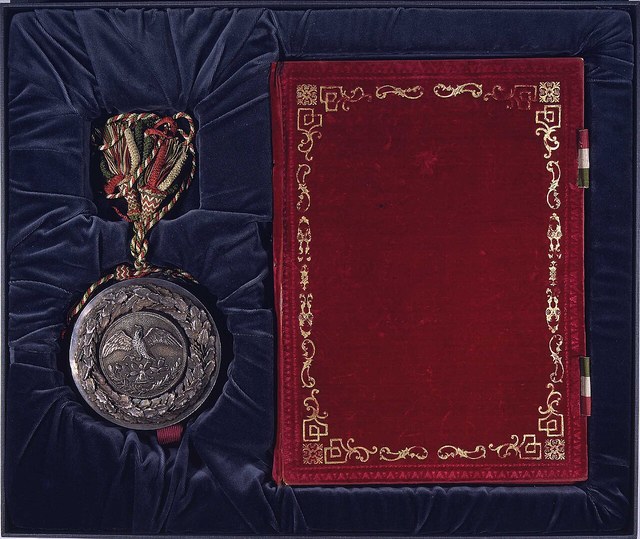
Treaty of Guadalupe Hidalgo ended the Mexican-American War and transferred California and the Southwest to the United States.

The kit

  • Negotiation — Treaty of Guadalupe Hidalgo was negotiated by Nicholas Trist, who was fired for insubordination upon returning to Washington.
  • Territorial provisions — Treaty of Guadalupe Hidalgo established the Rio Grande as Texas's southern boundary and granted California to the United States.
  • Failed amendments — Treaty of Guadalupe Hidalgo rejected the Wilmot Proviso banning slavery in acquired territories, opposed by anti-expansionist Whigs.
  • Enforcement problems — Treaty of Guadalupe Hidalgo's Article XI was annulled after the U.S. found containing Comanche and Apache raids impossible.

Runs with

Mexican-American War
ended this conflict after the Thornton Affair open card →
Wilmot Proviso
failed amendment attempting to ban slavery in acquired lands open card →
Mexico
ceded California and Southwest territories to U.S. open card →
the Presidency
negotiator Trist fired by administration for insubordination open card →

The ladder · 9 clues

H

A failed amendment to this treaty obtaining even more land was proposed by Jefferson Davis, but opposed by Democratic leadership.

H

It was negotiated by a man who was fired upon returning to Washington for ignoring instructions to return home instead of negotiating; that man was a former pro-slavery consul in Havana named Nicholas Trist.

H

A reporter for the New York Herald named John Nugent was questioned by the Senate after he attained a leaked copy of this treaty.

H

Article XI [] of this treaty was annulled a year later after the U.S. found it impossible to contain Comanche raids.

M

The Wilmot Proviso was also not added to this treaty, which was opposed by anti-expansionist Whigs. name this 1848 treaty in which the US acquired California while ending the Mexican-American War.

M

This treaty’s Article 11 promised protection against Apache raids but proved unenforceable.

M

The Rio Grande was set as the southern boundary of Texas in this treaty, which granted California to the United States. For ten points, name this treaty that ended the Mexican-American war.

E

The Wilmot Proviso was a failed attempt at banning slavery in the territories acquired in this treaty. name this treaty that ended the Mexican-American War.

E

The chief negotiator of this treaty was Nicholas Trist.

10 more clues from the record
H

The goals of this agreement had been brought up earlier by John Slidell, and this treaty put an end to the war that began with the Thornton Affair.

H

This treaty’s Protocol of Queretaro was later ignored because one side’s representatives did not have the power to agree to it.

H

Rights established in this treaty’s Article 9 were affirmed by a three-amendment protocol signed by Nathan Clifford and others.

H

Dr. Richard Madden criticized a negotiator of this treaty because that man profited from slaving fees as U.S. Consul in Havana.

H

Amendments to this treaty were included in the Protocol of Queretaro, and it was preceded by a cessation of hostilities known as the Capitulation of Cahuenga.

H

This treaty’s American negotiator was immediately fired for insubordination when news of its signing reached Washington.

H

The Treaty of Cahuenga [[kah-HWENG-ah]] was a predecessor to this treaty, signed in-part by prominent rancher Andrés Pico.

H

The Wilmot Proviso banning slavery in the territory acquired failed to be added to this treaty.

H

This treaty superseded a partial agreement signed the previous year in the Treaty of Cahuenga.

H

Delays in the drafting of this document led to the seizure of the merchant ship Betsey until this document was finalized. :Name this treaty, whose final version was negotiated by Thomas Barclay and notably did not include stipulations about tribute.

Watch out: Treaty of Cahuenga, a predecessor agreement signed the previous year
#897 · US Treaties and Diplomatic Agreements · Level 1

North American Free Trade Agreement

North American Free Trade Agreement
Nicoguaro · CC BY 3.0

trilateral trade agreement · signed 1992, effective 1994 · North America

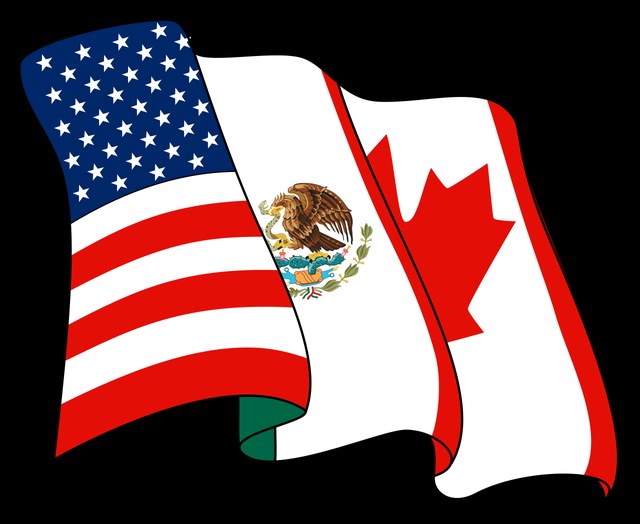
North American Free Trade Agreement eliminated most trade barriers between the United States, Canada, and Mexico starting January 1, 1994.

The kit

  • Creation — North American Free Trade Agreement was first signed by George H.W. Bush and Carlos Salinas in 1992, with Brian Mulroney negotiating for Canada.
  • Economic effects — North American Free Trade Agreement caused maquiladoras to proliferate, Mexican factories importing parts to produce finished goods with annually easing restrictions.
  • Opposition — North American Free Trade Agreement was opposed by Ross Perot's "giant sucking sound" prediction and sparked the Zapatista rebellion in Chiapas on its effective date.
  • Replacement — North American Free Trade Agreement was replaced by the USMCA under President Trump, who called it the worst trade deal in American history.

Runs with

Mexico
southern signatory with maquiladoras open card →
Canada
northern signatory represented by Mulroney open card →
George H. W. Bush
first signed agreement in 1992 open card →
the Presidency
debated by Perot during campaign open card →

The ladder · 15 clues

H

The signing of this agreement sparked tensions in Chiapas, which led to support of the Zapatista movement.

H

This agreement resulted in an annual 5% easing of restrictions on the output of maquiladoras.

H

President Trump has called this “the worst trade deal ever” in American history. …Name this trade deal that was signed in 1992, and took effect in 1994, which links together the economies of Canada, the U.S., and Mexico.

H

Maquiladoras proliferated following the 1994 signing of, what free trade agreement between the U.S., Canada, and Mexico?

H

In 1992, the US and Mexico, as well as Canada, signed this economic agreement. One of the effects of this agreement was the creation of maquiladoras, Mexican factories that import parts to produce finished goods.

H

Following Ross Perot's most successful attempt at the Presidency, Perot embarked on a campaign against this legislation, predicting it would cause a "giant sucking sound." This legislation was championed in a televised debate by Al Gore, and its architects included Carlos Salinas and Brian Mulroney. name this continental trade pact.

H

A speech given in support of this agreement claimed that “the gains from this agreement will be your gains too.” The passage of this agreement led to a surge in the number of cheap-labor factories called maquiladoras.

M

Ross Perot argued against what 1990s international political agreement, claiming it would create a “giant sucking sound?”

M

Agreement signed by the Clinton administration, which was succeeded by Donald Trump’s USMCA.

M

The peso crisis occurred shortly after this agreement, despite the economic opportunities it was promised to create.

M

This agreement, which eliminated almost all of the tariffs between the United States, Canada and Mexico was signed during the last year of George H. W. Bush’s presidency.

M

The Zapatistas launched their uprising on the day that this trade agreement came into effect. This agreement eliminated most trade barriers between Mexico, the US, and Canada.

E

Carlos Salinas and George H.W. Bush first signed this agreement in 1992. name this trade agreement involving Canada, Mexico, and the United States.

E

This agreement was derided as a “giant sucking sound” by Ross Perot and it sparked a rebel movement in the Lacandon Jungle, the Zapatistas.

E

Drafted shortly after the Maastricht Treaty that created the European Union, name this agreement that set up a trade bloc between the U.S., Canada, and Mexico.

10 more clues from the record
H

Zapata names an agrarian movement in modern Mexico which originally formed to oppose this 1994 treaty, which created Free Trade Zones with Mexico's northern neighbors.

H

As a result, this treaty was publicly attacked in the Lacandon Jungle Declaration by a group led by the ski-mask wearing Subcomandante Marcos, the Zapatistas.

H

This treaty required one signatory to cancel Article 27 of its constitution, which guaranteed reparations of land to indigenous people.

H

This agreement led to the resolution of longstanding disputes about truck inspection and softwood lumber subsidies.

H

A year after successfully appearing on a Presidential ticket, Al Gore went on CNN to debate in favor of this bill.

H

This agreement was replaced by the USMCA, and Brian Mulroney negotiated this treaty for its northernmost member.

H

Answer these questions about relations between the United States and her northern neighbors, :This pact between Mexico, the United States, and Canada, implemented on January 1, 1994, was designed to increase cooperation on labor issues and eliminate some tariffs and international commerce barriers.

H

The panel on Article 1904 of this document only made one decision that didn’t involve the U.S. – an antidumping conclusion based on rolled steel – while a notable 2005 decision about this document was on the issue of softwood lumber.

H

Carlos Salinas de Gortari and Brian Mulroney helped create this entity, while another leader stated that it “means jobs.” On the day that this entity went into effect, the Zapatista Army launched a 12-day rebellion.

H

Name these controversies of international trade, .This 1992 attempt at greater integration among the economies of the U.S., Mexico, and Canada still engenders opposition despite positive annual growth rates in each country.

Watch out: Maastricht Treaty (drafted around same time, created European Union trade bloc)
#898 · US Treaties and Diplomatic Agreements · Level 2

Camp David Accords

Camp David Accords
Unknown author Unknown author /span or not provided · Public domain

Egyptian-Israeli peace agreement · 1978 · Camp David, Maryland

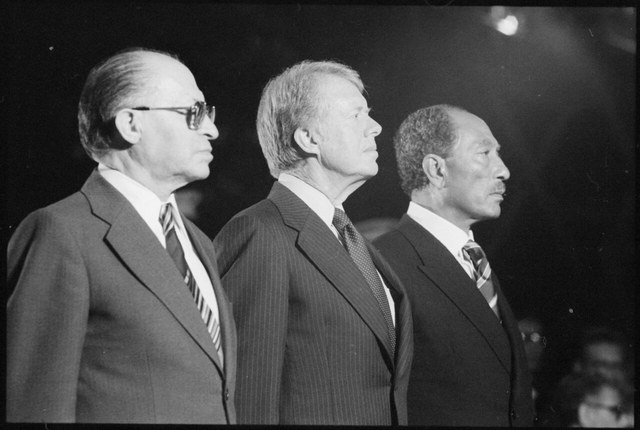
Camp David Accords were 1978 agreements brokered by Jimmy Carter establishing peace and borders between Egypt and Israel.

The kit

  • Negotiation — Camp David Accords were negotiated through shuttle diplomacy at Carter's presidential retreat in Maryland.
  • Key provisions — Camp David Accords guaranteed freedom of passage through the Straits of Tiran and Suez Canal and led to Sinai Peninsula's return.
  • UN response — Camp David Accords were condemned by UN Resolution 33/28 A for lacking PLO participation and not respecting Palestinian self-determination.
  • Aftermath — Camp David Accords led to Sadat's assassination by Khalid Islambouli three years after he received the Nobel Prize.

Runs with

Anwar Sadat
Egyptian president who signed and was assassinated for the agreement open card →
Jimmy Carter
U.S. president who brokered the agreement at his retreat open card →
Menachem Begin
Israeli prime minister who signed the agreement with Sadat open card →
Israel
nation that established peace and borders with Egypt open card →

The ladder · 9 clues

H

This agreement affirmed the importance of UN Security Council Resolution 242.

H

This agreement was the culmination of one nation’s desire to uphold UN Resolution 242.

H

Three years after receiving a Nobel Prize for this agreement, one of its signatories was assassinated by a group led by Khalid Islambouli.

H

These agreements were condemned by the United Nations in Resolution 33/28 A. As a result of signing these agreements, one negotiator was killed by Khalid Islambouli and Islamic Jihad.

M

Shuttle diplomacy was used in the making of this agreement, which failed to address the “right of return.” This agreement, which paved the way for the future Oslo Accords, called for freedom of passage in the Straits of Tiran and Suez Canal.

M

Sadat was assassinated for agreeing to peace with Israel in this 1978 agreement brokered by Jimmy Carter at a namesake Maryland country retreat.

M

In November of 1977, the leader of one nation that signed this agreement made a major address before the Knesset in Jerusalem.

E

These agreements established the border and a peace agreement between Egypt and Israel. name these 1978 agreements negotiated by Jimmy Carter at a Presidential retreat.

E

Before Israeli leaders signed the Oslo Accords, Anwar Sadat and Israeli PM Menachem Begin signed these agreements negotiated by Jimmy Carter in his presidential retreat.

10 more clues from the record
H

Secretary of State Cyrus Vance's efforts to help lay the groundwork for this agreement in the mid-1970s.

H

The United Nations rejected this agreement’s second framework due to the lack of PLO participation.

H

This agreement was called a “stab in the back” by Hafez Assad who, with King Hussein, called for it to be re-examined.

H

Tensions rose after its signing due to assumption of King Hussein’s willingness to agree to its terms.

H

It led to a framework for the eventual return of the Sinai Peninsula.

H

Mediation in this agreement was performed by Cyrus Vance.

H

One signatory to this agreement pledged to withdraw his military to the east of a line extending from El-Arish to Ras Muhammad, while the Strait of Tiran and the Gulf of Aqaba were guaranteed as international waterways by this agreement.

H

These agreements included the deconstruction of airbases near Yamit and along the Gulf of Aqaba, as well as rights of passage through the Strait of Tiran and the Suez Canal.

H

The Preamble to these agreements mentions “four wars during 30 years”, and another part of these agreements established a strong local police force including Jordanian citizens.

H

Resolution 34/65 B was invoked by the United Nations to reject parts of this agreement because it did not respect Palestine’s right of self-determination.

Watch out: Oslo Accords (later Israeli-Palestinian agreement that Camp David paved the way for)
#899 · US Treaties and Diplomatic Agreements · Level 2

Jay's Treaty

Jay's Treaty
Public domain

1794 U.S.-Britain treaty · 1794 · United States and Britain

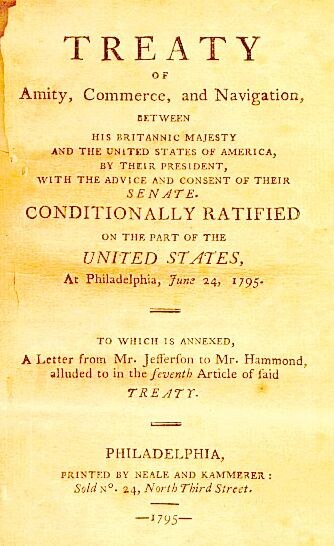
Jay's Treaty was negotiated by the first Chief Justice to resolve issues from the Treaty of Paris and end British occupation of frontier forts.

The kit

  • Negotiations — Jay's Treaty was designed by Alexander Hamilton and negotiated by Chief Justice John Jay, who threatened to join a league of neutrality with Denmark and Sweden.
  • Provisions — Jay's Treaty secured British evacuation of frontier forts in the Northwest Territories, expanded American trade with most-favored-nation status, but failed to end impressment.
  • Controversy — Jay's Treaty sparked massive opposition when details leaked to the Aurora newspaper, leading to Jay being burned in effigy across the country and Frederick Muhlenberg being stabbed.
  • Legacy — Jay's Treaty was supported in Alexander Hamilton's "Camillus" letters and Fisher Ames's congressional speech, but helped usher in the First Party System through Democratic-Republican opposition.

Runs with

Alexander Hamilton
designed the treaty and defended it in "Camillus" letters open card →
Treaty of Paris
resolved lasting issues from this earlier agreement open card →
Native Americans
Article III protected Canadian-born Native emigration rights open card →
Paris

The ladder · 9 clues

H

In this settlement, a former minister to Spain negotiated the evacuation of frontier forts and the expansion of American trade, but when details of this pact were leaked to the Aurora newspaper, its negotiator was burned in effigy.

H

Copies of this document were burned in front of George Hammond's house, and Frederick Muhlenberg was stabbed for signing this document.

H

This treaty, which was supported in the “Camillus” letters, references the non-existent St. Croix River as a boundary.

H

It was supported under the pseudonym of Camillus by Alexander Hamilton, while Fisher Ames gave a speech in favor of it as a Congressman from .

M

That namesake of this treaty said that he could travel across the country by the light of effigies depicting him being burned.

M

The Monroe-Pinkney Treaty, which would have replaced this treaty after its expiration, was rejected by a vocal opponent of this treaty, Thomas Jefferson.

M

Fort au Fer [] was vacated through this treaty, which granted most-favored-nation status.

E

Meant to resolve lasting issues from the Treaty of Paris and the French Revolution, what treaty was negotiated by the first Chief Justice of the U.S. Supreme Court?

E

Frederick Muhlenberg, who provided the tie-breaking vote to ratify this agreement, was stabbed by his own brother-in-law over his vote. name this agreement, designed by Alexander Hamilton, that failed to end the impressment of American sailors by British ships but opened trade with the U.K.

10 more clues from the record
H

This treaty's Article III outlined legal protections for the emigration of Canadian- born Native Americans into the United States.

H

Chief Justice Oliver Ellsworth wrote an advisory opinion rejecting the House's right to decide this treaty's merits.

H

Issues over forts in the Mackinac [[MAK-in-aw]] and Maumee regions, as well as sailor impressment, were dealt with in this treaty.

H

According to this treaty, Native Americans born in Canada can get domestic tuition fees in the US.

H

The First Party system was partially ushered in by this treaty, which was heavily opposed by Democratic-Republicans.

H

During the negotiations for this treaty, the U.S. ineffectively threatened to join a league of neutrality with Denmark and Sweden.

H

name these treaties signed by America in the 18th century.A future Supreme Court justice negotiated this 1794 treaty with Great Britain designed by Alexander Hamilton to resolve some issues left over from the Revolutionary War.

H

Rutledge's downfall was sparked by his vociferous criticism of this 1794 treaty, which extended the Treaty of Paris and was negotiated and named for Rutledge's aforementioned predecessor in his highest office. It resulted in British troops vacating the Northwest Territories.

H

This unpopular US-Britain agreement failed to end naval impressment, but did negotiate Britain’s withdrawal from forts in the west. Washington sent its American signatory in his role as Chief Justice.

H

Granting free passage between the and to all those half Native American or more, it set the Saint Croix river as the northeastern boundary of the .

Watch out: Monroe-Pinkney Treaty was proposed to replace it after expiration
#900 · US Treaties and Diplomatic Agreements · Level 2

Adams-Onís Treaty

Adams-Onís Treaty
CC BY-SA 2.5

1819 U.S.-Spain treaty · 1819 · United States and Spain

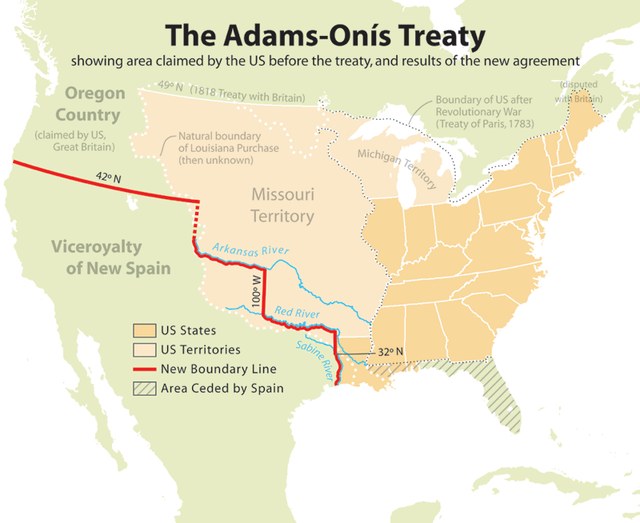
Adams-Onís Treaty was an 1819 agreement in which Spain ceded Florida to the United States and established the southwestern boundary.

The kit

  • Territory exchange — Adams-Onís Treaty saw the United States trade its claims to Texas for Florida and Spanish Oregon.
  • Boundary terms — Adams-Onís Treaty established the "step boundary" and set Spain's northern claims at the 42nd parallel.
  • Negotiation context — Adams-Onís Treaty followed Andrew Jackson's raids on Seminole lands in Florida, pressuring Spain to negotiate.
  • Implementation — Adams-Onís Treaty's ratification was delayed because Spain wanted to withhold recognition from South American revolutionaries.

Runs with

Florida
Spain ceded Florida to U.S. open card →
Spain
Mexico
gained independence 1821, altering treaty terms open card →
Texas

The ladder · 9 clues

H

One party to this treaty renounced all land claims above the 42nd parallel in exchange for recognition of its then- ownership of Texas to the Sabine River.

H

A portion of the region discussed in this treaty was claimed in the 1792 voyage of Robert Gray.

H

1819 agreement in which James Monroe’s Secretary of State secured Florida for the United States.

H

Hyde de Neuville intervened to pass this treaty, which caused controversy because the Neches and Sabine Rivers were found to be reversed on maps.

M

Favorable terms were negotiated for one side in this treaty afteRr Andrew Jackson continually raided Seminole lands.

M

John Quincy Adams negotiated this treaty as Secretary of State. name this 1819 treaty by which Spain sold Florida to the U.S.

M

The following year, this treaty traded American claims to Texas for Florida and Spanish Oregon.

E

This treaty did not remain in force for long, because in 1821, Mexico gained its independence. name this 1819 treaty in which Spain ceded Florida to the United States.

E

1819 treaty that finalized the purchase of Florida from Spain, named for its two negotiators.

10 more clues from the record
H

Under the terms of this treaty, Tobias Watkins led a commission that heard private compensation claims, for which the U.S. assumed financial responsibility.

H

Ratification of this treaty was delayed because one country wanted to withhold diplomatic recognition from South American revolutionaries.

H

The "step boundary" was established by this treaty, which cleared the way for Stephen Long's scientific expedition the following year.

H

Some negotiations over land grants in this treaty were conducted by John Forsyth in his first overseas position.

H

Many of the provisions of this treaty were altered two years later by the Treaty of Cordoba, which officially recognized the independence of Mexico.

H

The territory in question was demarcated using Melishe’s Map and one measure guaranteed that one side had not been compensated for the actions of French privateers to avoid double reparations.

H

Article 12 reaffirmed the Treaty of Limits and Navigations signed between the two parties 24 years earlier and the sixteenth and final article confirmed the signatures of the two negotiators of this Treaty of Amity, Settlement and Limits.

H

This treaty created the “Step Boundary” due in part to the belief that the source of a certain river lay near the 42nd parallel.

H

During his tenure, Adams also negotiated this treaty with Spain in which the United States bought Florida and formally established its border with Mexico.

H

One impetus for this agreement was the raids conducted from the “Negro Fort”, now Fort Gadsden.

Watch out: Treaty provisions were altered by the 1821 Treaty of Cordoba recognizing Mexican independence
#901 · US Treaties and Diplomatic Agreements · Level 2

Pinckney's Treaty

Pinckney's Treaty
Drdpw · CC BY-SA 4.0

1795 U.S.-Spain treaty · 1795 · San Lorenzo, Spain

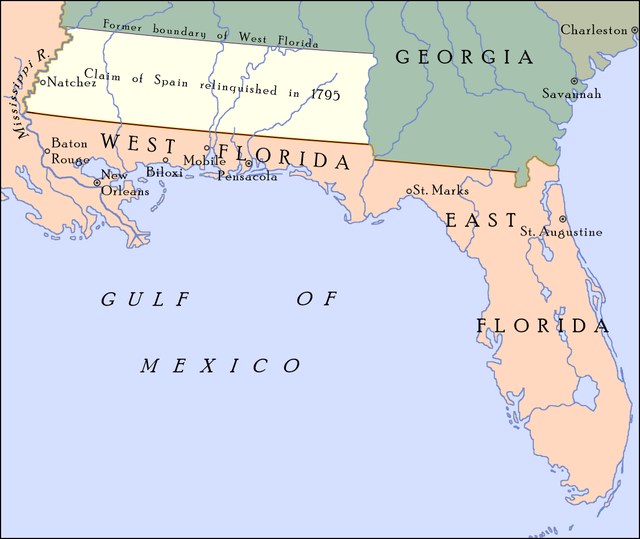
Pinckney's Treaty resolved the West Florida Controversy and established American navigation rights on the Mississippi River.

The kit

  • Borders — Pinckney's Treaty set the 31st parallel as the northern boundary of Spanish Florida and the southern U.S. border.
  • Navigation rights — Pinckney's Treaty guaranteed free navigation of the Mississippi and the right of deposit in New Orleans for three years.
  • Territorial outcomes — Pinckney's Treaty led to the formation of a territory with capital Natchez and resolved ownership of the Tombigbee and Natchez districts.
  • Legacy — Pinckney's Treaty was the subject of a 1927 Pulitzer Prize-winning book by Samuel Flagg Bemis.

Runs with

Florida
set northern boundary at 31st parallel open card →
Mississippi River
guaranteed U.S. navigation rights open card →
Spain
signed with Manuel de Godoy open card →
New Orleans
granted right of deposit for 3 years open card →

The ladder · 9 clues

H

As a result of this treaty, a surveying team placed the Ellicott Stone on the Saint Stephens meridian.

H

Following the Peace of Basel, the "Prince of Peace" moved to sign this treaty, which was the subject of a 1927 Pulitzer Prize-winning book by Samuel Flagg Bemis.

H

In part, it guaranteed free navigation of the Mississippi and the right of deposit in New Orleans for 3 years.

H

The cessation of a line between the Pearl and Perdido Rivers was agreed upon as part of this treaty.

M

Ownership rights over the Tombigbee and Natchez districts were discussed as part of this treaty, which resolved the West Florida Controversy and gave the United States navigation rights of the Mississippi River.

M

earlier treaty which had established the southern border of the U.S. along the Florida-Georgia line?

M

A territory with capital Natchez was formed as a result of this treaty, which also granted the United States the right to navigate the Mississippi River.

E

Under this treaty, the 31st parallel was set as the northern boundary for the Florida colony. name this 1795 treaty of friendship between Spain and the United States.

E

This treaty was signed with Manuel de Godoy and named for a South Carolina politician. name this 1795 treaty between the U.S. and Spain, which defined the border of Florida and guaranteed American navigation on the Mississippi River.

4 more clues from the record
H

The evacuation of Walnut Hills was overseen by Andrew Ellicott after the signing of this treaty.

H

In the wake of Pavia, Francis negotiated this 1526 treaty which purported to renounce all claims to Burgundy, Flanders, and Artois.

H

In 1839 the Spanish invoked Article 9 of this treaty in its petition that the cargo and slaves of the Amistad be returned.

M

Necessary to settle issues left unresolved by the Jay-Gardoqui Treaty and the Treaty of 1783, it is also called the Treaty of San Lorenzo. identify this 1795 American-Spanish treaty that set the southern US boundary at the 31st parallel.

#902 · US Treaties and Diplomatic Agreements · Level 2

Gadsden Purchase

Gadsden Purchase
b Original: /b /a /div PhilFree /a /div Vector: /div Xceptic · Public domain

1853 U.S.-Mexico land purchase · 1853–1854 · southern Arizona and New Mexico

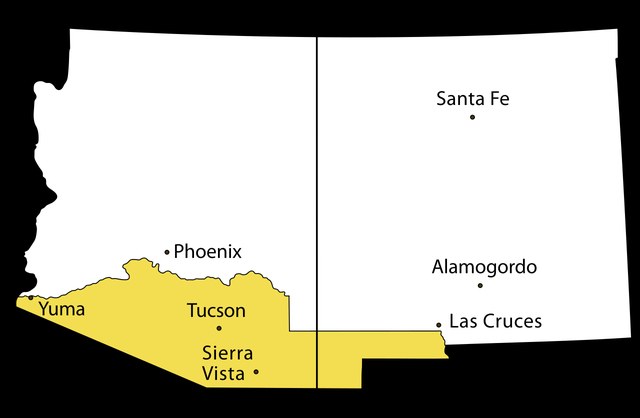
Gadsden Purchase was an 1853 treaty in which the United States paid Mexico ten million dollars for land to secure a southern transcontinental railroad route.

The kit

  • Purpose — Gadsden Purchase was intended to provide a route for a transcontinental railroad and resolve border disputes from the Treaty of Guadalupe Hidalgo.
  • Territory — Gadsden Purchase included large portions of southern Arizona and New Mexico, encompassing the Mesilla Valley and cities such as Tucson and Sierra Vista.
  • Provisions — Gadsden Purchase resolved Mesilla Valley land claims and included provisions for moving mail and goods across the Isthmus of Tehuantepec.
  • Ratification — Gadsden Purchase was ratified after northern senators reduced the payment by five million dollars, which bankrupt Mexico accepted.

Runs with

Railroad
secured land for southern transcontinental railroad route open card →
Mexico
sold territory to U.S. for ten million dollars open card →
Land
New Mexico
southern portion acquired in purchase open card →

The ladder · 9 clues

H

The Treaty of Guadalupe Hidalgo was later altered by this 1853 land deal which was meant to secure a route for a transcontinental railroad.

H

2: It was intended to be used as a route for a future transcontinental railroad, and also served to clear up border disputes that had arisen from the Treaty of Guadalupe-Hidalgo.

H

Christopher Ward advised a negotiator on one side of this agreement to settle the rejection of the Garay colonies project.

H

This agreement included a provision for moving mail and goods across the Isthmus of Tehuantepec, and this treaty resolved disputes over Mesilla Valley land claims.

M

Pierce’s ambassador to Mexico negotiated this namesake purchase, in which he obtained part of what now makes up southern New Mexico and Arizona.

M

The ratified version of this agreement included protections for land on which both Peter Hargous and A.G. Sloo planned to build a railroad.

M

It included large portions of southern Arizona and New Mexico, and cities such as Tucson and Sierra Vista. :Name this 1854 agreement between U.S. and Mexico, which enabled the construction of a transcontinental railroad.

E

President Pierce signed this 1853 treaty in which America paid 10 million dollars to Mexico for a strip of land in southern New Mexico and Arizona.

E

That railroad secured in this agreement was never built but had been intended to cross the Isthmus of Tehauntepec. Ownership of the Mesilla Valley was resolved in this agreement which had been left undecided at the earlier negotiations to end the Mexican-American War. name this American land acquisition agreement with Mexico.

10 more clues from the record
H

Governor William Lane forced the negotiation of this event, which was the high-water mark for William Marcy and other proponents of a southern route for the Transcontinental Railroad.

H

This event resulted in a ten million dollar price being paid for the Mesilla Valley area.

H

The resulting nine article treaty resolved the confusion created by John Disturnell’s mapping errors, and, in its text, authorized commercial transit across the Isthmus of Tehuantepec and voided the sixth and seventh articles of the treaty signed between the same two nations five years earlier, with the exception of the provision involving the Rio Bravo del Forte.

H

Some of the causes for its negotiation were the issuance of almost identical rival grants to P.A. Hargous and Albert Sloo for a vital communications corridor and the failure of the United States to control American Indian migration under Article IX of a previous treaty.

H

An article by A.B. Gray described the "exceedingly beautiful and silky" cotton made available by this agreement; that article was reported on in DeBow's Review, whose editor J.D.B. DeBow was a major publicizer of this agreement's benefits.

H

An immediate predecessor to this agreement came when a commission under Robert Campbell allowed William Emory to complete a survey to revise an earlier compromise made by Bartlett and Conde.

H

A block of northern senators held up its ratification until the sum of money involved was reduced by five million dollars, which the Mexican government accepted due to bankruptcy.

H

Another notable land deal in American history is this $10 million purchase from Mexico, intended to provide land for a southern transcontinental railroad. The land involved is home to the city of Tucson.

H

Five years later, the McLane–Ocampo Treaty reinforced this agreement’s Article 8, which called for a port in the area near present-day Rocky Point.

H

The failure of this agreement's namesake to negotiate an unrelated 1832 treaty led to the Second Seminole War, during which that namesake served as quartermaster-general of the Florida Volunteers.

Watch out: Treaty of Guadalupe Hidalgo—earlier 1848 treaty that Gadsden Purchase modified
#903 · US Treaties and Diplomatic Agreements · Level 2

Treaty of New Echota

Treaty of New Echota
p Anthony Finley Co. of Philadelphia br /p Uploaded by WillO · Public domain

1835 Cherokee removal treaty · December 29, 1835 · New Echota, Georgia

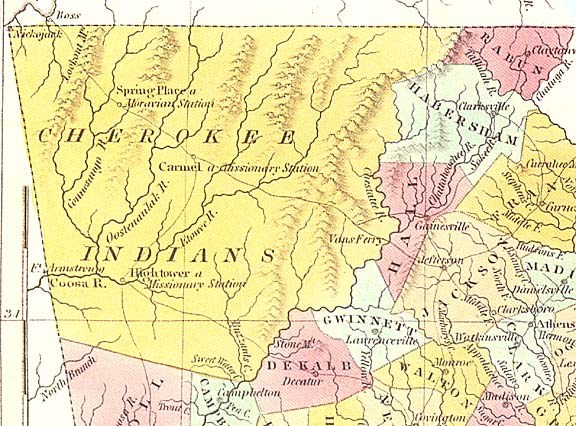
Treaty of New Echota was signed by a minority Cherokee faction agreeing to relocate the tribe west of the Mississippi River.

The kit

  • Signing — Treaty of New Echota was signed by Elias Boudinot, John Ridge, and Stand Watie without Principal Chief John Ross's approval.
  • Opposition — Treaty of New Echota faced resistance from John Ross, who collected over 14,000 signatures protesting its invalid signing.
  • Ratification — Treaty of New Echota was ratified by the Senate by only one vote despite lacking support from the Cherokee National Party.
  • Enforcement — Treaty of New Echota provided the legal basis for the Trail of Tears, forcing Cherokee relocation to Oklahoma.

Runs with

Cherokee
ceded Cherokee lands east of Mississippi for Oklahoma territory open card →
John
John Ross led opposition and collected 14,000 protest signatures open card →
Trail of Tears
provided the legal justification for forced Cherokee removal open card →
Andrew Jackson
strongly supported by President Andrew Jackson open card →

The ladder · 9 clues

H

This treaty resulted in the payment of five million dollars in exchange for a tribe's lands east of the Mississippi River.

H

John Walker Jr. was assassinated for supporting the policy advanced by this treaty, which was signed by Elias Boudinot, John Ridge, and Stand Watie.

H

During a reading of the text of this treaty by Benjamin Currey, the roof of the house containing negotiators caught fire, which one bystander thought “emblematical of the indignation of Heaven at the unlawful proceedings within.” Hugh White's vote in favor of this treaty helped him win the state of Tennessee in the following presidential election.

H

John Ross and his National Party led opposition to this document, which was ratified in the Senate by only one vote. :Name this document, whose legitimacy derived from the minority opinion of a group led by Stand Watie and Elias Boudinot.

M

This treaty, named for the capital of the Cherokee nation, agreed to exchange Cherokee lands for settlements in Oklahoma. The Senate ratified it even though it lacked Principal Chief John Ross’ signature.

M

The Trail of Tears began after some Cherokee signed this 1835 treaty. John Ross tried to stop the US from ratifying and enforcing this treaty.

M

A group of Cherokees claiming to speak for the entire tribe signed this 1835 treaty promising that the tribe would relocate west of the Mississippi. Chief John Ross’s letter protesting this treaty was ignored.

E

Signed on December 29, 1835, and strongly supported by Andrew Jackson, name this treaty which relocated the Cherokee, whose enforcement led to the Trail of Tears.

E

In 1835, the Cherokee signed this treaty, agreeing to give up their territory in the southeast and move to Indian territory. It was the legal basis for the subsequent trail of tears.

9 more clues from the record
H

The signing of this treaty prompted John Ross, the leader of a group opposed to this treaty, to collect more than 14,000 signatures attesting to its invalid signing and submit them to Lewis Cass.

H

In the Cherokee community, there is still a rift over the signing of this notorious 1835 treaty, which was supposed to guarantee Cherokee representation in Congress.

H

Part of the impetus for the Cherokee Trail of Tears was this 1836 treaty signed in Georgia that set the terms for the removal of the entire Cherokee tribe.

H

It provided for the Board of Commissioners for Foreign Missions to be paid according to appraisals made by George Vashon, Abraham Redfield, and A. P. Chouteau.

H

General John Wool resigned his command in protest instead of enforcing this treaty, which was negotiated by William Carroll and John Schermerhorn.

H

Some of the Cherokee signed this treaty in 1835, although none of their chiefs agreed. This treaty, named after the last Cherokee capital, ceded their land to the US.

H

It was steadfastly opposed by John Ross, and the group that was involved in it, known as the “Ridge Party,” was in violation of the law.

H

It followed an earlier council at Red Clay, after which William Carroll and John Schmerhorn were appointed commissioners.

M

John Ross lobbied against the ratification of this 1836 treaty by which the conditions for the removal of the Cherokees were outlined.

#904 · US Treaties and Diplomatic Agreements · Level 2

Webster-Ashburton Treaty

Webster-Ashburton Treaty
US Government · Public domain

1842 US-British border treaty · 1842 · US-Canada border

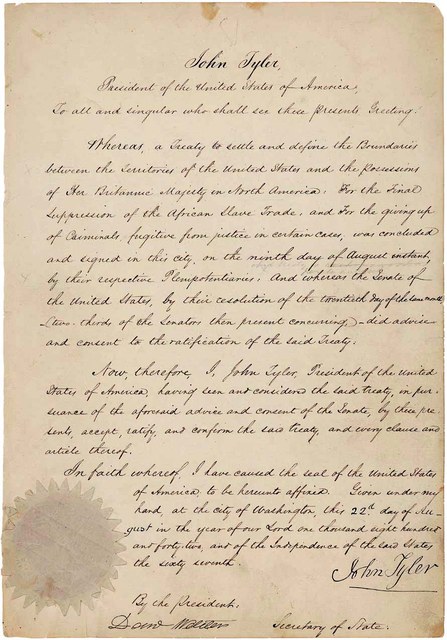
Webster-Ashburton Treaty was an 1842 agreement between the United States and Great Britain that settled the border between Maine and New Brunswick.

The kit

  • Border settlement — Webster-Ashburton Treaty ended the Aroostook War by granting 7,015 square miles of disputed territory to the parties involved.
  • Western boundaries — Webster-Ashburton Treaty reaffirmed existing boundaries between the US and Canada, including the Northwest Angle and Lake of the Woods.
  • Slave trade provision — Webster-Ashburton Treaty's Article 9 required both parties to maintain cruisers off the coast of Africa to suppress the slave trade.
  • Extradition clause — Webster-Ashburton Treaty's Article 10 addressed extradition issues highlighted by the Caroline Affair involving political fugitives from Upper Canada Rebellion.

Runs with

Maine
set border between Maine and New Brunswick open card →
Aroostook War
ended the Aroostook War open card →
Canada
settled multiple border disputes with Canada open card →
John
negotiated by John Tyler's Secretary of State open card →

The ladder · 9 clues

H

Tyler worked with his Secretary of State in 1842 to negotiate this treaty with Great Britain, which set a border between Maine and New Brunswick, ending the Aroostook War.

H

Its ffh article created a “Disputed Territory Fund” and required payment of three hundred thousand dollars.

H

The boundary line negotiated in this treaty was largely based on stone markers laid 70 years earlier by surveyors Thomas Valentine and John Collins.

H

After Benjamin fled to England, this treaty made extradition impossible, because he was not directly involved in the Lincoln assassination.

M

The Aroostook war was ended by this treaty, which set the boundary between Lake Superior and the Lake of the Woods. It also attempted to end the slave trade on the high seas.

M

Existing boundaries between the U.S. and Canada such as the border around the Northwest Angle were reaffirmed by this treaty, which settled a dispute between loggers along the Saint John River. name this treaty that ended the Aroostook War.

M

Granting 7,015 square miles of disputed territory to one of the parties, it also defined the boundaries from Lake of the Woods 49 degrees north to the Rocky Mountains, but the question of Oregon was left undecided. – name this US-Britain treaty of 1842 named after two diplomats, which concluded the so-called Aroostook War.

E

In 1842, this treaty settled the boundary between Maine and New Brunswick and normalized relations between the U.S. and Britain.

E

This 1842 agreement primarily settled the border with Canada but also clarified treatment of fugitives and settled the Creole case, which Benjamin had argued.

10 more clues from the record
H

During the negotiations for this treaty, both parties ignored the ramifications of a contemporary slave revolt in the Creole case.

H

This treaty laid out conciliatory statements regarding the arrest and trial of Alexander McLeod.

H

In Article 9, the parties agreed to maintain cruisers off the coast of Africa to help enforce the abolition of the slave trade, while Article 10 dealt with extradition, an issue highlighted by the Caroline Affair involving political fugitives from the failed Upper Canada Rebellion.

H

Its eighth article, which was stipulated to last for five years, dealt with the suppression of the slave trade through the stationing of ships on the coast of Africa. One border dispute that it resolved involved the construction of the appropriately named Fort Blunder inside foreign territory.

H

Negotiated by the only cabinet holdover of one participating country’s previous administration, a coup of signing this document, which had been presaged by terms John Harvey and Winfield Scott had earlier established, was gaining the Mesabi Range.

H

Among the few accomplishments of Tyler’s presidency was this treaty of 1842 which officially set the US-Canadian border. Its American namesake was the only Cabinet member not to resign upon Tyler’s taking office. After finishing the treaty, he resigned too.

H

The tensions between Britain and the United States caused by the Creole rebellion were lessened by this 1842 treaty, which clearly defined the borders separating Maine and New Brunswick. It resulted in the United States gaining control of the Arostook Valley.

H

Nelson Hackett's case helped introduce a clause into this treaty protecting slaves from extradition. :Name this treaty, which addressed several border disputes between the U.S. and Canada. This 1842 treaty is partially-named after John Tyler's Secretary of State.

H

This treaty assigned ownership of a ruined citadel called Fort Blunder and aimed to remedy a dispute arising from reliance on the Mitchell Map, which erroneously displayed the Mississippi River watershed.

H

Fort Montgomery was built on Island Point after it was ceded to the United States in this agreement. :Name this 1842 agreement that fixed the border between Maine and New Brunswick, which was the point of contention in the Aroostook War.

Watch out: Fort Montgomery was built on Island Point after it was ceded to the United States in this agreement
#905 · US Treaties and Diplomatic Agreements · Level 2

Treaty of Payne’s Landing

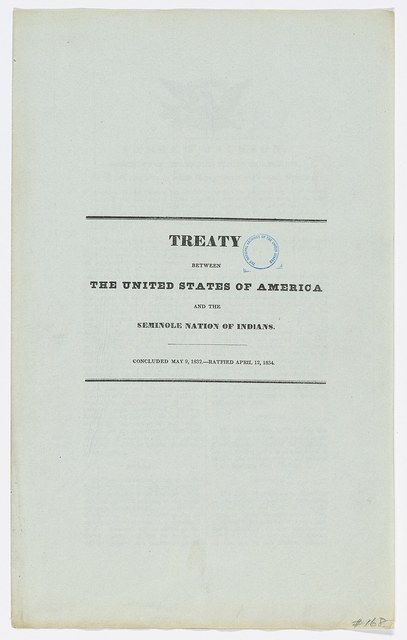
Treaty of Payne’s Landing
U.S. Government. 3/4 · Public domain

1832 US-Seminole treaty · 1832 · Florida

Treaty of Payne's Landing was an 1832 agreement forcing the Seminoles to relocate west from Florida, leading to the Second Seminole War.

The kit

  • Context — Treaty of Payne's Landing followed the Treaty of Moultrie Creek a decade earlier, which had confined Seminoles to Floridian reservations.
  • Terms — Treaty of Payne's Landing gave the Seminoles a three-year period to vacate Florida and relocate to Indian Territory in Oklahoma.
  • Negotiation — Treaty of Payne's Landing included provisions that Seminole interpreters Abraham and Cudjo would receive two hundred dollars, with Ya-ha Hadjo among the leaders.
  • Resistance — Treaty of Payne's Landing sparked the Second Seminole War when tribes refused to relocate, with Osceola openly opposing the agreement.

Runs with

Seminole people
forced the Seminoles to relocate west to Oklahoma open card →
Osceola
openly opposed by Osceola who resisted relocation open card →
Florida
required Seminoles to vacate Florida within three years open card →
Indian Removal Act
implemented the Indian Removal Act against Seminoles open card →

The ladder · 9 clues

H

A decade after taking control of Floridian land in the Treaty of Moultrie Creek, the US government forced the Seminoles into this 1832 agreement that coerced them into moving west.

H

1832 treaty that forced the aforementioned tribe out of Florida following the Indian Removal Act.

H

Osceola openly opposed the signing of this 1832 treaty, which gave the Seminoles a three year period to vacate Florida and relocate to Indian territory in Oklahoma.

H

One side in this treaty negotiated that their interpreters Abraham and Cudjo would receive two hundred dollars in payment, and one leader of that side was Ya-ha Hadjo.

H

This treaty ended a war that was sparked when Neamathla refused to surrender some of his warriors.

H

It followed the signing of a treaty at Camp Moultrie earlier in the conflict it ended.

M

The refusal of some tribes to go led to the Second Seminole War.

M

Another war between the parties to this treaty began three years after its ratification, and that war saw the Dade Massacre occur.

E

This 1832 treaty called for the Seminoles to move west out of Florida. The Seminoles’ refusal to relocate after this treaty was signed led to the Second Seminole War.

Watch out: Treaty of Moultrie Creek (earlier 1823 treaty that confined Seminoles to Florida reservations)
#1364 · Vietnam War Events and Campaigns · Level 3

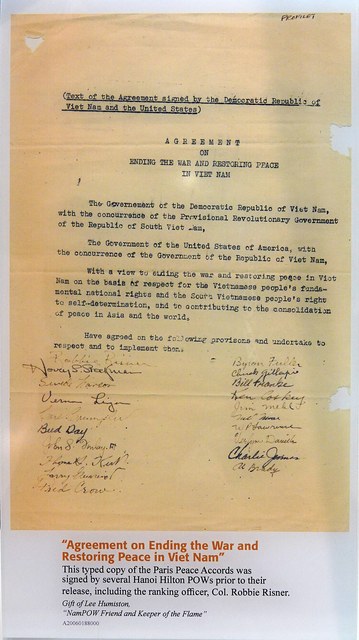
Paris Peace Accords

Paris Peace Accords
Sanjay Acharya · CC BY-SA 4.0

1973 Vietnam peace treaty · 1973 · Paris

Paris Peace Accords were 1973 agreements negotiated by Henry Kissinger and Lê Đức Thọ to establish a cease-fire ending the Vietnam War.

The kit

  • Negotiations — Paris Peace Accords negotiations were preceded by Operation Linebacker II attacks and reportedly sabotaged by Richard Nixon in early attempts.
  • Procedural disputes — Paris Peace Accords negotiators debated table shapes, ultimately compromising with a circular table and peripheral square tables for different delegations.
  • Implementation — Paris Peace Accords called for a commission led by Canada, Hungary, Indonesia, and Poland to implement the cease-fire provisions.
  • Recognition — Paris Peace Accords negotiations earned Henry Kissinger and Lê Đức Thọ the 1973 Nobel Peace Prize for their diplomatic efforts.

Runs with

Paris
signed in Paris after extended negotiations open card →
Vietnam War
intended to end the Vietnam War open card →
Henry Kissinger
negotiated by Kissinger for the United States open card →
New York City

The ladder · 6 clues

H

Anna Chennault became a “channel to Mr. Thiˆeu” during this treaty’s negotiations. name this treaty for which Lˆe Du´c Tho and Henry Kissinger were awarded the Nobel Peace Prize in 1973.

H

In the lead-up to this agreement, one side transferred vast amounts of military equipment to another in Operation Enhance.

H

W. Averell Harriman headed proceedings for this treaty which called for a commission led by Canada, Hungary, Indonesia, and Poland to implement a cease-fire.

H

An early roadblock for this treaty’s negotiators was the fact that one side demanded a circular table, while the other wanted a rectangular one.

H

A compromise reached during the negotiation of this treaty included the use of a circular table, while square tables were located peripherally.

M

Henry Kissinger helped negotiate this 1973 peace accords that were supposed to end the Vietnam War.

4 more clues from the record
H

Reportedly, a politician used Anna Chennault as a secret channel of communication to a participant in this treaty.

H

Many historians believe that early attempts at negotiating this treaty were sabotaged by Richard Nixon.

H

The final version of this treaty was immediately preceded by the attacks of Operation Linebacker II.

H

William Nolde was killed eleven hours before the signing of this agreement.

Watch out: Anna Chennault served as a secret channel during negotiations, not as an official negotiator