The 1648 Codex · study package

US Political Parties & Factions

16 terms drawn from across the corpus, in study-list order. Art and cross-links point back to the home category cards.

#758 · US Political Parties and Factions · Level 2

Republican Party

Republican Party
Republican Party of American Samoa · CC BY-SA 4.0

American political party · 1854–present · United States

Republican Party is the American political party founded in 1854 to oppose the Kansas-Nebraska Act and slavery expansion.

The kit

  • Rise — Republican Party formed in Ripon, Wisconsin in 1854 and nominated John C. Fremont as its first Presidential candidate in 1856.
  • Achievements — Republican Party first won the White House in 1860 when Abraham Lincoln was elected President.
  • Conflicts — Republican Party split into Stalwart and Half-Breed factions over the spoils system until the Pendleton Civil Service Act passed.
  • Legacy — Republican Party's Radical wing pushed for impeachment during Reconstruction under the leadership of Thaddeus Stevens.

Runs with

the Presidency
won in 1860 with Lincoln open card →
Kansas-Nebraska Act
founded in opposition to it open card →
James G. Blaine
Abraham Lincoln
first Republican President, 1860 open card →

The ladder · 9 clues

H

Thaddeus Stevens lead a "Radical" wing of this party during Reconstruction. :Name this political party that won the Presidency in 1860 when Abraham Lincoln won office.

H

In 1856, Fremont became the first Presidential candidate from this new political party that had formed in Ripon, Wisconsin.

H

This political party formed in 1854 in opposition to the Kansas-Nebraska Act. It nominated John C. Fremont as its first Presidential nominee in 1856 and first won the White House in 1860.

H

Roscoe Conkling notably led one faction of this party, of which Charles Guiteau claimed to be a member.

M

A candidate from this political party was supported by the “A Time For Choosing” speech and used the slogan “AuH O.” [spell it out] This party nominated Barry Goldwater for President in 1964; he lost 2 to Lyndon Johnson, but his nominating convention featured a breakthrough moment for future President from this party, Ronald Reagan.

M

This party sponsored John C. Fremont in its first presidential election.

M

One election that saw the rise of the "merit system" involved the Stalwart and Half-Breed factions of this party.

E

Garfield, Blaine, and Guiteau were all members of this political party, which had split into the factions of half-breeds, stalwarts, mugwumps.

E

The GOP is an alternate name for this American political party that opposes the Democrats.

10 more clues from the record
H

In 1980, a strategist for this party leaked to the press that Tom Turnipseed “got hooked up to jumper cables,” thus making fun of depression.

H

When preceded by “National”, this names a short-lived political party led by Henry Clay and John Quincy Adams.

H

When preceded by “Liberal”, this word names a splinter party that nominated Horace Greeley for president.

H

Political party, founded to oppose slavery, that nominated him for President in 1860.

H

Most commonly, this word names a party founded in Ripon, Wisconsin.

H

This party was the subject of Rick Perlstein's 2001 book Before the Storm.

H

Party's "Radical" members pushed for the impeachment?

H

The issue of the spoils system divided this political party into factions called Stalwarts and Half Breeds until the passage of the Pendleton Civil Service Act by Chester Arthur, himself a member of this political party.

H

More recently, eight members of the Georgia State Assembly did this in 2010, though former Senator Zell Miller has notably not done this act.

H

In the first decades of the twentieth century, this organization was divided into “lily-white” and “black and tan” factions over the issue of African-American participation.
Watch out: National Republican Party was a separate short-lived party led by Henry Clay and John Quincy Adams
#759 · US Political Parties and Factions · Level 2

Democratic Party

Democratic Party
bdi Iris Tong /span /a · Public domain

U.S. political party · 1828–present · United States

The Democratic Party is a U.S. political party founded by Andrew Jackson that opposes the Republicans and is symbolized by a donkey.

The kit

  • Rise — The Democratic Party evolved from Thomas Jefferson's party after an ideological split between James Monroe and Martin van Buren in the 1820s.
  • Historical factions — The Democratic Party's historical factions included the white supremacist Redeemers, the pro-big business Bourbons, and William Jennings Bryan's Populists.
  • Solid South — The Democratic Party controlled the "Solid South" until losing it after the 1964 Civil Rights Act and Reagan-era Republican Southern Strategy.
  • Legacy — The Democratic Party was supported by Tammany Hall in New York and experienced a 1954 revolution in Hawai'i when it won the Territorial Legislature.

Runs with

Andrew Jackson
founded the Democratic Party open card →
Martin Van Buren
split with Monroe led to party's evolution open card →
ChancellorStrategic Hamlet Program

The ladder · 9 clues

H

Represented by a donkey, what U.S. political party opposes the Republicans?

H

The Whigs were founded to counter this political party led by Andrew Jackson.

H

This party evolved out of one founded by Thomas Jefferson after an ideological split between James Monroe and Martin van Buren.

H

This party's historical factions included the white supremacist Redeemers, the pro-big business Bourbons, and the Populists of William Jennings Bryan.

M

Bryan ran on this party’s ticket in 1896, gaining Populist votes. This party was founded by Andrew Jackson and opposes the Republican Party.

M

Polk belonged to this American political party, which opposed the Whigs from the 1820s to the 1850s. Andrew Jackson also belonged to this party, which took as its symbol a donkey.

M

One leader of this party reportedly claimed that it had “lost the South for a generation” after he signed the Civil Rights Act of 1964, and this party’s Presidential nominee has only won South Carolina once since 1960. name this American political party opposed by the Republicans.

M

Tammany Hall tried to make sure that candidates of this political party were elected, supporting members such as Robert Wagner and Al Smith.

E

Stephen Douglas ran for president as a member of this party, but lost to a rival party led by Abraham Lincoln. name this American political party that opposes the Republicans.

10 more clues from the record
H

Azariah Flagg and Silas Wright led a wing of this party that opposed corruption as a farmer would oppose rats in a barn.

H

This party accepted opponent William Pitt Kellogg's election as governor of Louisiana in exchange for house seats in the Wheeler Compromise.

H

Perceived progressive members of this party, who favored internal improvements and state banks, were labeled Hunkers.

H

This party controlled the "Solid South," though it lost control of Southern states during the Reagan era.

H

The Albany Regency was opposed by this party’s Barnburner faction which also opposed James Polk.

H

Its rival used the “Southern Strategy” to convert members of this party.

H

Wilson was the first president from this party since Grover Cleveland.

H

Was in what party opposed by the Whigs during his term?

H

Members of this party formed the Barnwell Ring.

H

John A. Burns was the first member of this party to be elected Governor of Hawai'i. :Name this party, which experienced a namesake revolution in 1954, where it won a majority in Hawai'i's Territorial Legislature over the Republicans.

Watch out: Whig Party (opposed Democrats in 1820s–1850s, not to be confused as Democratic faction)
#760 · US Political Parties and Factions · Level 2

Tammany Hall

Tammany Hall
PBrieux · CC BY-SA 4.0

New York political machine · 1789–1960s · New York City

Tammany Hall was a Democratic Party political machine in New York City notorious for corruption under Boss Tweed and control through patronage.

The kit

  • Rise — Tammany Hall was founded by William Mooney as its first Grand Sachem and developed by Aaron Burr into a powerful organization.
  • Achievements — Tammany Hall maintained control of lower-class votes, particularly poor Irish immigrants, through machine tactics and the spoils system.
  • Conflicts — Tammany Hall's leader fell from grace after failing to prevent the Orange Riots, a clash between Irish Protestants and Catholics.
  • Legacy — Tammany Hall declined after Fiorello La Guardia's 1934 mayoral election and faded under Carmine De Sapio in the 1960s.

Runs with

New York City
controlled New York City politics through Democratic Party machine open card →
William Marcy Tweed
reached peak corruption under Boss Tweed's leadership open card →
William
founded by William Mooney as first Grand Sachem open card →
Thomas Nast
exposed by Thomas Nast's cartoons depicting Tweed with money-bag head open card →

The ladder · 9 clues

H

A leader of this organization fell from grace after failing to prevent the Orange Riots, a clash between Irish Protestants and Catholics.

H

This organization, which declined after the mayoral election of Fiorello La Guardia in 1934, achieved notoriety for its corruption and abuse of the spoils system under Boss Tweed. name this New York City political machine.

H

This organization partially titles the autobiography of its one-time leading member, George Plunkitt.

H

A 1911 Act named after a leader of this organization known as "Big Tim" was one of the U.S.'s first gun control laws.

M

This group was led by a Grand Sachem, the first of which was William Mooney.

M

Bourbons such as Tilden put the nail in the coffin of Boss Tweed, the head of this notoriously corrupt New York City political machine that enjoyed the support of poor Irish immigrants.

M

Later leaders of this organization include Charles Murphy and Bowery tough “Big Tim” Sullivan.

E

Thomas Nast depicted the “boss” of this political organization, William Tweed, with a money bag for a head. name this corrupt political machine from New York.

E

Political machine of New York led by the infamous "Boss" Tweed which was known for its rampant corruption.

10 more clues from the record
H

This organization’s last gasp of power was under Carmine De Sapio.

H

Plunkitt was a member of this political machine, whose leaders were known as Sachems.

H

This organization turned off the lights in meetings to stifle dissidents, leading their opposition to be called the Locofocos.

H

This organization, led by “Honest” John Kelly, faded away shortly after the fall of Carmine DiSapio.

H

A member of this organization, George Washington Plunkitt, distinguished between “dishonest” and “honest graft.” This organization tried to break up a meeting of William Legget’s Locofocos by shutting off gaslights at a meeting.

H

Name these players in New York City politics .This executive circle of the city’s Democratic Party used machine tactics to maintain control of the lower class vote until it was outmaneuvered by Franklin Roosevelt.

H

After this organization shut off the gaslights to silence their opposition, a group that opposed this organization started meeting under matchlight and became known as the locofocos.

H

This group pulled its support for Jimmy Walker, partly because of his frequent affairs with “chorus girls.” An image captioned “Let Us Prey” depicted this group’s members as vultures.

H

The first Catholic nominee for president, Al Smith, was strongly backed by this organization, which was developed by Aaron Burr but lost influence during Franklin D. Roosevelt’s governorship.

H

This institution was very popular among Irish immigrants, was mocked by the cartoons of reformer Thomas Nast, and was once led by the corrupt “Boss” Tweed.

Watch out: Students may confuse leaders William Mooney (first Grand Sachem) with Boss Tweed (most notorious leader)
#761 · US Political Parties and Factions · Level 2

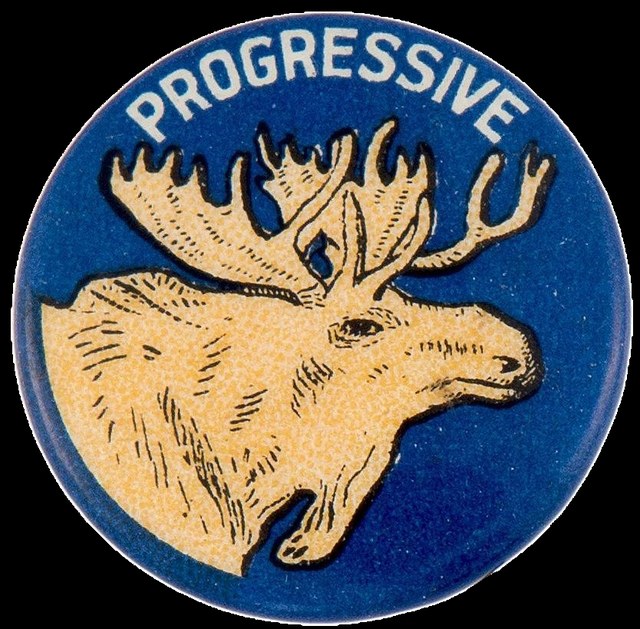
Bull Moose Party

Bull Moose Party
span lang="en" Anonymous /span Unknown author · Public domain

American political party · 1912, revived 1924 and 1948 · United States

Bull Moose Party was Theodore Roosevelt's 1912 third-party vehicle that finished second, beating incumbent Republican William Howard Taft.

The kit

  • Rise — Bull Moose Party earned its nickname after Roosevelt declared he was "fit as a bull moose" when launching his 1912 presidential campaign.
  • Achievements — Bull Moose Party became the only third party to finish ahead of the Republicans, with Roosevelt winning California in the state's closest race.
  • Conflicts — Bull Moose Party candidate Roosevelt continued his campaign speech after John Flammang Schrank shot him, saved by a steel eyeglass case.
  • Legacy — Bull Moose Party was revived for Robert La Follette's 1924 presidential run and again for Henry Wallace decades later.

Runs with

Theodore Roosevelt
Roosevelt was the Bull Moose Party's 1912 presidential nominee and its leader open card →
George
George Perkins provided major funding but was mocked as 'Gabby George' by Gifford Pinchot open card →
Henry
California
Bull Moose Party won California in the state's closest presidential race open card →

The ladder · 9 clues

H

One of these parties earned a nickname after a politician running on its party’s ticket quipped that he was as “fit as a bull moose.” Robert La Follette’s 1924 presidential bid and Teddy Roosevelt’s final presidential bid were made under the banners of this political ideology that sought reform in the early 20th century.

H

One political party of this name adopted the slogan “Fight for Peace.” Hiram Johnson ran for vice president with a party of this name, and three decades later, Henry Wallace revived this political party for his presidential run.

H

It was chaired by Hiram Johnson, who became its Vice-Presidential candidate.

H

This party’s national candidate won California in the state's closest race in a presidential election.

M

Political party he ran for President with in 1912.

M

This party earned its popular name after that candidate declared he was "strong as a" certain animal. name this party that nominated Theodore Roosevelt for U.S. president in 1912.

M

In that election, this party's presidential candidate continued a campaign speech after being shot.

E

This political party nominated Henry Wallace and Robert LaFollete as its candidates for President.

E

A party with this name actually garnered more votes in a Presidential election than a major candidate, beating the incumbent Republican president William Howard Taft. name this party that Teddy Roosevelt ran under in the Election of 1912.

10 more clues from the record
H

This party, later revived for reformer Robert La Follette’s [[luh-FAH-lets]] 1924 presidential run, first formed after William Howard Taft beat an opponent at the RNC.

H

This party claimed to adhere to "New Nationalism" and a "Square Deal," becoming the only third party to finish ahead of the Republicans when that party nominated William H. Taft.

H

Saloon owner John Flammang Schrank shot a candidate of this party, failing to kill him due to the presence of a steel eyeglass case.

H

A presidential candidate from this party continued a speech despite having a bullet lodged inside him after an assassination attempt by John Flammang Schrank.

H

This party's initial financial backers included U.S. Steel magnate Frank Munsey.

H

One of its financial backers freely distributed copies of its leader's "Confession of Faith" and was denounced by another member of this party as "Gabby George." George Perkins was thus mocked by Gifford Pinchot, whose conflict with Ballinger contributed to the founding of this party at Chicago's Orchestra Hall.

H

Its leader declared that “We stand at Armageddon” in the “Confession of Faith ” speech given at its formative convention in Chicago, while funding for it was largely provided by Frank Munsey and George Perkins, both of whom were criticized for their corporate ties.

H

For their first terms, Walter Marion Chandler of New York and Roy Woodruff of Michigan were elected to Congress under the banner of this party, and Miles Poindexter spent two years as its only serving senator.

H

Roosevelt led this center-left party after 1912 and beat William Taft and only lost toWoodrow Wilson in that year’s election. It is also called the “Bull Moose” party after Roosevelt survived an assassination attempt.

H

One of this party's candidates for Boston mayor commissioned the writing of the song “Charlie on the MTA” and was fined ten dollars for his only apparent campaign activity, which was driving around Boston in a van blasting the song from a loudspeaker.

Watch out: Henry Wallace ran under a Progressive Party banner, but this was a later revival, not the original 1912 Bull Moose organization
#762 · US Political Parties and Factions · Level 2

Sons of Liberty

Sons of Liberty
Public domain

Colonial Patriot organization · 1765–1776 · American colonies

Sons of Liberty was a secretive Patriot organization founded by Samuel Adams to oppose British taxation without representation.

The kit

  • Rise — Sons of Liberty emerged from the Loyal Nine in 1765 to oppose the Stamp Act, with separate branches forming in Boston and New York.
  • Achievements — Sons of Liberty carried out the Boston Tea Party after members dressed as Mohawk Indians and dumped tea into Boston Harbor.
  • Conflicts — Sons of Liberty burned the Gaspee in Narragansett Bay and tortured tax collector John Malcolm through tarring and feathering.
  • Legacy — Sons of Liberty erected liberty poles topped with Phrygian caps, leading to the Battle of Golden Hill when British soldiers cut them down.

Runs with

Boston
Boston Tea Party
dressed as Mohawks and carried out this protest open card →
Stamp Act of 1765
founded to oppose this taxation measure open card →
Rhode Island
Providence branch burned the Gaspee open card →

The ladder · 9 clues

H

Clement Vallandingham lead a reorganized Knights of the Golden Circle that titled themselves “The Order of” this earlier group.

H

The Loyal Nine, a predecessor to this organization, hung Andrew Oliver in effigy and raided Lieutenant Governor Thomas Hutchinson’s house while protesting a certain piece of legislation.

H

The burning of the Gaspee was carried out by Captain Whipple and John Brown who mobilized members of the Providence branch of this group to help. This quasi-organized group became more famous for a tea party a few years later.

H

In one instance, this group opposed taxation without representation by dressing up as Mohawk Indians and boarding three ships in Boston Harbor.Name this revolutionary group that included Samuel Adams and John Hancock that was responsible for the Boston Tea Party.

M

Secretive organization of Patriots founded by Samuel Adams.

M

Penelope Barker’s organization of the Edenton Tea Party inspired this organization to organize a protest in which they poured tea into Boston Harbor.

M

Mulligan had been involved with the Patriot cause well before the Revolutionary War began, having joined this secret society a decade before. In Rhode Island, members of this group attacked and set fire to the Gaspee.

M

James Otis and Samuel Adams were among the founders of this underground group of colonial revolutionaries that arose in opposition to the Stamp Act.

E

This organization viciously tortured John Malcolm shortly after an event where several members dressed up as Native Americans for an event that led to the Intolerable Acts. name this organization that carried out the Boston Tea Party.

10 more clues from the record
H

Herman Melville was awfully proud of his "doubly revolutionary descent." Name some things about it, :On his father's side, Melville descended from Thomas Melvill, a member of this colonial group who perpetrated the Boston Tea Party.

H

Emerging from a group called the “Loyal Nine,” which included publishers John Gill and Benjamin Edes, this group emerged from the Committees of Correspondence, with New York and Boston branches forming separately.

H

One of the first acts by this group was the burning of an effigy of Andrew Oliver near a boot with a papier-mache devil emerging, the latter a play on the name of the Earl of Bute.

H

The tea-dumpers were drawn from this secret organization, led in part by Samuel Adams. They were responsible for the tarring and feathering of many a British tax collector.

H

This organization erected a granite monument featuring an inscription by Nathaniel Ames, originally topped with a now-missing wooden column and bust.

H

A group claiming descent from this organization became a lodge for socialist miners in West Virginia which passed the “Red Man Act” in response.

H

The Battle of Golden Hill broke out after sticks topped with Phrygian caps put up by this organization were repeatedly cut down.

H

This group was responsible for the capture of a repository at Turtle Bay, and their habit of erecting large poles lead to the Battle of Golden Hill.

H

Members of this group were responsible for the death of William Dudingston and aided Abraham Whipple in the capture of a ship in Narragansett Bay.

H

This organization met underneath an elm tree from which they hung a boot in protest of Lord Bute.

Watch out: Knights of the Golden Circle later called themselves 'Order of' this group
#763 · US Political Parties and Factions · Level 2

Federalist Party

Federalist Party
Raymond1922A · CC BY-SA 3.0

Early American political party · 1789–1816 · United States

Federalist Party was the conservative, centralizing party of Alexander Hamilton and John Adams that dominated the First Party System.

The kit

  • Rise — Federalist Party shaped its platform around Alexander Hamilton's vision of strong central government and commercial development.
  • Conflicts — Federalist Party opposed the War of 1812 and discussed removing the Three-Fifths Compromise at the Hartford Convention.
  • Death & succession — Federalist Party collapsed after the Hartford Convention, with Rufus King as its last presidential nominee in 1816.
  • Legacy — Federalist Party members wore black cockades in their hats and were accused of treason as the Blue Light faction.

Runs with

Hartford Convention
Federalist delegates dominated this convention opposing the War of 1812 open card →
John Adams
Alexander Hamilton
Hamilton shaped the Federalist Party platform and ideology open card →
War of 1812
Federalist Party opposition to this war led to Hartford Convention open card →

The ladder · 9 clues

H

Several members of this party who opposed a provisional constitution of Massachusetts were derisively called the Essex Junto.

H

Other members of this party were accused of signaling for British ships and were called the Blue Light faction.

H

A subset of this political party based in Essex County advocated secession from the United States.

H

Members of this party wore black cockades in their hats, and at one point were accused of treason for using “blue lights” to guide enemy warships.

M

This party collapsed after discussing the removal of the Three-Fifths Compromise and the possible secession of New England at the Hartford Convention.

M

Most delegates to the Hartford Convention were members of this party, whose platform was shaped by Alexander Hamilton.

M

At the Hartford Convention, members of this party discussed its opposition to the War of 1812.

E

The First Party System included the Democratic- Republicans and this centralizing conservative party. name this party of John Adams and Alexander Hamilton.

E

This party’s last presidential nominee was Rufus King, who ran in the Election of 1816.

10 more clues from the record
H

Rufus King was the last presidential candidate nominated by this party, which formed the Hartford Convention to galvanize opposition to the War of 1812.

H

This party twice nominated Charles Pinckney for President, with Pinckney soundly losing both times.

H

Early U.S. political party which collapsed following the Hartford Convention of 1814-15.

H

Despite not running a candidate in the Election of 1820, this party managed to earn sixteen percent of the popular vote.

H

Fisher Ames was a leader of this party in the House of Representatives.

H

This party fielded its final presidential candidate in the same year that candidate lost the New York governorship election to Daniel D. Tompkins.

H

Some members of this party were called “blue-lighters” for sending treasonous maritime signals.

H

This party's last informal presidential nominee, Rufus King, lost in a landslide to the man who previously succeeded him as Ambassador to Great Britain.

H

In the Philadelphia paper The Port Folio, members of this party wrote a welcome platform under pseudonyms until Nicholas Biddle became its editor.

H

To maintain this party’s base of power, Arthur St. Clair wanted to split the state of Ohio into two parts.

Watch out: Essex Junto—a derisive name for Massachusetts Federalists who opposed a provisional state constitution, not a separate party
#764 · US Political Parties and Factions · Level 2

Populist Party

Populist Party
Namkhanh02 · Public domain

American political party · 1892–1908 · United States

Populist Party was a left-wing agrarian third party that advocated for farmers and workers against banks and railroads.

The kit

  • Rise — Populist Party incorporated the Ocala Demands into its Omaha Platform, which called for rail nationalization and free silver coinage.
  • Achievements — Populist Party nominated James B. Weaver in 1892, who won five western states and split North Dakota's electoral votes.
  • Conflicts — Populist Party nominated William Jennings Bryan for president and Thomas Watson for vice president in 1896 in a temporary alliance with Democrats.
  • Legacy — Populist Party collapsed after Bryan's defeat, with Thomas Watson receiving only 29,000 votes as its last presidential nominee in 1908.

Runs with

James
James B. Weaver was first presidential nominee in 1892 open card →
William Jennings Bryan
nominated for president in 1896 alliance with Democrats open card →
Silver
Omaha Platform called for free silver coinage open card →
Gold

The ladder · 9 clues

H

Marion Butler ran on a fusion ticket combining this party with Republicans in North Carolina.

H

A predecessor to this party articulated its goals in the Ocala Demands, which this party incorporated in its Omaha platform.

H

Ignatius Donnelly partially wrote this party’s Omaha Platform, which called for the elimination of private banks.

H

A member of this party earned the nickname “Sockless Jerry” in a election against J.R. Hallowell.

M

This party outlined its beliefs in the Omaha Platform.

M

This party nominated Thomas Watson for vice president in a temporary alliance with the Democrats.

M

Along with the Democrats, this left-wing party nominated William Jennings Bryan in 1892 shortly before collapsing. name this late-19th century agrarian third party.

E

In 1896, this party nominated a ticket of Thomas Watson and William Jennings Bryan for president. name this left- wing agrarian party.

E

This party, which issued the Omaha Platform, supported rail nationalization and free silver coinage. name this farmers' party which enjoyed brief success behind William Jennings Bryan.

10 more clues from the record
H

This third party nominated James B. Weaver in 1892, who won five western states. This party advocated for the rights of farmers and urban workers.

H

Bryan’s presidential campaign was backed by this third party, which crusaded against banks and railroads on behalf of poor farmers.

H

Thomas E. Watson was this party’s last nominee for President, receiving just over 29,000 votes in 1908.

H

Ignatius Donnely wrote the preamble to the platform for this party, and its first presidential candidate, who won only four states, was James Baird Weaver.

H

A novel promoting this political party explained that Baron Rothe was manipulating American currency and was written by the creator of its pamphlet Coin's Financial School.

H

With Grover Cleveland and Benjamin Harrison, this party’s candidate, James Weaver, evenly split North Dakota's three electoral votes.

H

Left-wing agrarian party that supported him through many of his presidential runs.

H

L.L. Polk founded this party, almost becoming its 1892 presidential nominee.

H

This party was dubbed "gibbering idiots" by the "sage of Emporia," William White.

H

In 1900, members of this party gathered in Cincinnati to nominate William Baker.

Watch out: Bryan was the Democratic nominee; Populists endorsed him rather than originating his candidacy
#765 · US Political Parties and Factions · Level 2

Whig Party

Whig Party
N. Currier (firm) · Public domain

American political party · 1834–1856 · United States

Whig Party was an American political party formed in 1834 to oppose Andrew Jackson and the Democrats.

The kit

  • Rise — Whig Party was created in 1834 as an opposition party to Jacksonian Democrats and shared its name with a British anti-Tory party.
  • Achievements — Whig Party supported the American System of national improvements and ran war heroes William Henry Harrison and Zachary Taylor for president.
  • Conflicts — Whig Party split into "Cotton" and "Conscience" factions over slavery, with the latter founding the Free Soil Party.
  • Legacy — Whig Party evolved into the Republican Party after nominating Millard Fillmore as its final candidate in 1856.

Runs with

Henry Clay
founded party and promoted American System open card →
Liberia
William Henry Harrison
won log cabin campaign as nominee open card →
John Tyler
shunned as His Accidency after tariff open card →

The ladder · 9 clues

H

This political party split along the issue of slavery into its “Cotton” and “Conscience” factions.

H

The hair color of Francis Granger named the “Silver Gray” faction of this party, whose southern successor, the Constitutional Union Party, ran John Bell the “Great Apostate” for president.

H

One member of this party gave the longest Presidential inauguration speech in history.

H

This party supported national improvements as part of the American System. name this American political party whose members included a young Abraham Lincoln, as well as leaders such as William Henry Harrison and Henry Clay.

M

What American political party of Henry Clay nominated both William Henry Harrison and Zachary Taylor?

M

Proponents of the American System, this party ran William Harrison, Zachary Taylor, and Henry Clay for president.

M

Political party to which Walpole belonged. They opposed the Tories and the concept of absolute monarchy.

E

Following the Mexican-American War, Winfield Scott and Zachary Taylor competed for the nomination of this political party.

E

Created in 1834 as an opposition party to the Jacksonian democrats, name this American Party that shared its name with a British Party that opposed the Tories.

10 more clues from the record
H

William Tubman served as president for 27 years under a party with this name, which is the oldest political party in Liberia.

H

Horace Mann, who established a model for public schools in Massachusetts, was a member of this party, as was its “Conscience” faction that founded the Free Soil Party.

H

In its first presidential election, this party tried to split the vote regionally by running four different candidates.

H

This party won the “log cabin and apple cider” campaign by depicting a wealthy nominee as a man of the people nicknamed “Tippecanoe.” Its only two elected presidents were both generals who died in office.

H

In 1856, this political party nominated Millard Fillmore as their final Presidential candidate, despite the fact that he had already been nominated by the Know-Nothing Party.

H

One member of this political party had an affair with Georgianna Cavendish and helped craft a document that outlawed slavery in the British Empire.

H

A President from this party known as “His Accidency” was shunned by this party after signing the Tariff of 1842.

H

One faction of this group which was led by Francis Granger supported the former editor of the Buffalo Commercial Advertiser, who had been earlier defeated in a governor's race by Silas Wright, against his intra-party rival, a future Secretary of State and ally of Thurlow Weed.

H

During the speech, Ogle compared William Henry Harrison to a “silver spoon” in an attempt to showcase him as the ideal candidate for this party. This party was split into Conscience and Cotton factions during disputes over slavery.

H

This political party evolved into the Republican Party and was created by Henry Clay. :Name this party formed in opposition to Andrew Jackson. This political party nominated war heroes like Winfield Scott for President.

Watch out: British Whig Party (opposed Tories and absolute monarchy; American party borrowed the name)
#766 · US Political Parties and Factions · Level 2

Know Nothing Party

Know Nothing Party
American Party (1844-1860) · Public domain

American nativist political party · 1844–1860 · United States

Know Nothing Party was a nativist political party that opposed Catholic and immigrant influence in 1840s–1850s America.

The kit

  • Rise — Know Nothing Party grew out of the secret Order of the Star Spangled Banner beginning in 1849.
  • Achievements — Know Nothing Party won all but three seats in the Massachusetts legislature in 1854 and finished second nationally.
  • Conflicts — Know Nothing Party clashed with Catholics on "Bloody Monday" in Louisville and sparked riots after Thomas Swann's Baltimore mayoral election.
  • Legacy — Know Nothing Party fielded Millard Fillmore for president in 1856, winning only Maryland before dissolving.

Runs with

Baltimore
riots broke out after Thomas Swann elected mayor open card →
Millard Fillmore
nominated him as presidential candidate in 1856 open card →
mayor
Levi Boone closed Sunday taverns as Chicago mayor open card →
Philadelphia

The ladder · 9 clues

H

This party's members included Levi Boone, who closed taverns on Sundays in the lead-up to the Lager Beer riot of German immigrants.

H

This party clashed with Catholics on “Bloody Monday” in Louisville, Kentucky.

H

This party expanded women’s rights after winning all but three seats in the Massachusetts legislature in 1854.

H

Moniker given to the nativist American Party because its members professed ignorance of it when asked.

M

This party’s candidate won a single state, Maryland, in the 1856 US presidential election. name this US nativist party which nominated Millard Fillmore in 1856 and held to anti-Catholic and anti-immigrant platforms.

M

First led by Lewis Charles Levin, this party was originally created as the Native American Party.

M

Officially the Native American Party, what is this nativist political party whose colloquial name came from members denying its existence?

E

This party grew out of the secret “Order of the Star Spangled Banner.” Millard Fillmore ran as a member of this party in the 1856 election.

E

In 1856, Fillmore was nominated for president by this nativist third party, whose main political goal was to reduce immigration.

10 more clues from the record
H

Riots named for this party broke out after Thomas Swann was elected mayor of Baltimore.

H

One political party was created because it felt that Catholic immigrants were gaining too much control of the US in the 1840's. :Name this party which only fielded a presidential candidate in 1856.

H

During the 1854 electoral season, this party won the second-most popular votes ahead of the Whigs but behind the dominant Democratic Party.

H

John Edward Bouligny, a Creole member of this party, was the only Louisiana representative to refuse to sign the secession from the Union.

H

Members of this party include a governor who ordered the burning of railroad bridges leading to Baltimore.

H

A major leader of this party defected to become the Republican governor of Massachussetts; that was Nathaniel Banks.

H

Answer the following about an American history, :This movement, which sought to curb the influence and power of newly arrived Roman Catholics, was composed of loosely associated secret orders including the “Order of the Spangled Banner.”

H

It emerged from the Order of the Star-Spangled Banner, which began holding secret meetings in 1849. :Identify this political party, which was officially known as the American party but took its better-known name from a catchphrase used by its members.

H

Poole was an active member of this nativist political party founded in 1844 by Lewis Levin whose derisive-sounding nickname referred to its members' extreme secrecy.

H

Although some supported temperance, the only vice presidential candidate of this political party was based out of Tulip Grove and was Andrew Donelson.

Watch out: Officially called the American Party or Native American Party, not to be confused with modern Native American political movements
#767 · US Political Parties and Factions · Level 2

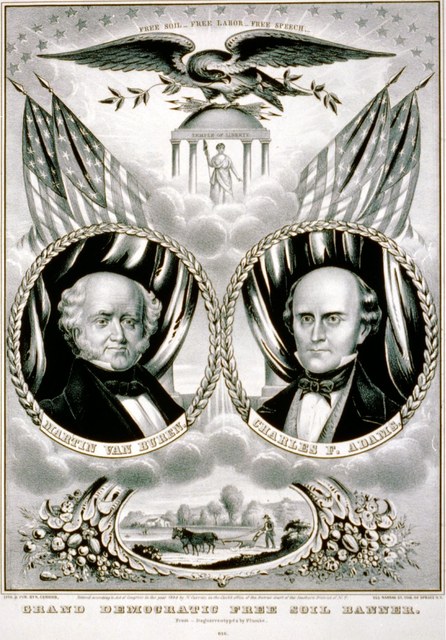
Free Soil Party

Free Soil Party
Nathaniel Currier firm · Public domain

Anti-slavery third party · 1848–1854 · United States

Free Soil Party was an American third party that opposed slavery's expansion into new territories from 1848 until absorption by Republicans.

The kit

  • Formation — Free Soil Party formed in 1848 when Barnburner Democrats withdrew support from Lewis Cass at a Buffalo convention.
  • Platform — Free Soil Party supporters favored the Wilmot Proviso and opposed the Compromise of 1850 and Kansas-Nebraska Act.
  • Electoral performance — Free Soil Party nominated Martin Van Buren in 1848, capturing ten percent of the popular vote, mostly from New York.
  • Collapse — Free Soil Party collapsed after its second national election when John Hale and George Washington Julian failed to capture 5% of votes.

Runs with

Martin Van Buren
former president who ran as Free Soil presidential nominee in 1848 open card →
Slavery
party opposed slavery's expansion into new western territories open card →
1848
year the party formed and ran its first presidential ticket open card →
John
John Hale served as senator and final presidential nominee for the party open card →

The ladder · 9 clues

H

This party collapsed after only its second national election when a ticket of John Hale and George Washington Julian failed to capture even 5% of the popular vote.

H

This party, whose final presidential nominee was John P. Hale, emerged when the Barnburners withdrew their support from Lewis Cass, instead nominating Martin Van Buren for the presidency. name this anti-slavery party tht was active from 1848 until its absorption by the Republican Party.

H

This party, which partially formed from Barnburner Democrats, nominated a former president as its candidate, though it only won ten percent of the popular vote.

H

Salmon P. Chase served six years in the Senate as a member of this political party.

M

In 1844, Charles Francis Adams and Martin van Buren ran as a ticket for, what mid-19th century American third party which opposed the expansion of slavery?

M

Supporters of this party favored the Wilmot Proviso, though it failed to stop the Kansas -Nebraska Act. (*) For ten points , name this anti -slavery third party whose ticket in the 1848 presidential election was led by Martin Van Buren.

M

This party's members included Senators Salmon P. Chase and John Hale.

E

This political party nominated John Hale and Martin van Buren for president, and this party strongly opposed the Compromise of 1850. name this party named for its opposition to slavery in new lands.

E

The Barnburners helped form this party after the Democratic Convention refused to endorse the Wilmot Proviso.

10 more clues from the record
H

This party's vice-presidential candidates included George Julian and Charles Francis Adams.

H

Running on this party's ticket, education reformer Horace Mann lost an election for governor of Massachusetts.

H

All six signers of the Appeal of the Independent Democrats left to join this party.

H

An Indianapolis newspaper named for this political party's Banner published from 1948 to 1954.

H

Nearly a third of supporters in its best year came from New York State, which prevented that state from going Democratic. Many of its backers were New York Democrats who quarreled with the Hunkers and started this party at a convention in Buffalo.

H

This third party came together in 1848, breaking from the Democrats. :What party demanded that slavery be outlawed in new territories, captured in their slogan which also included “Free Speech, Free Labor, and Free Men”?

H

Its second vice presidential candidate went on to propose a constitutional amendment providing for women’s suffrage and delivered a notable speech, “The Gospel of Reform,” in support of Samuel Tilden.

H

The political cartoon "Shooting the Christmas Turkey" shows another candidate from this party as a fox grabbing the turkey while two candidates from other parties bicker.

H

Its first vice presidential candidate wrote Conservatism and Reform and Struggle for Neutrality in America, and served as ambassador to Great Britain during the Civil War.

H

David Terry, the Chief Justice of the Supreme Court of California, mortally wounded senator David Broderick in a duel for supporting this political party.

Watch out: Charles Francis Adams was the first vice presidential candidate in 1848, not a presidential candidate in 1844
#768 · US Political Parties and Factions · Level 2

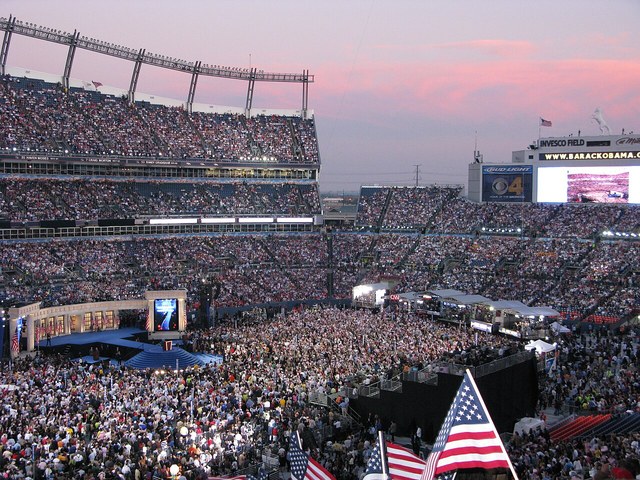
Democratic National Convention

Democratic National Convention
a rel="nofollow" Kelly DeLay · CC BY 2.0

Quadrennial political gathering · 1832–present · Various U.S. cities

Democratic National Convention is the quadrennial gathering where the Democratic Party formally nominates its presidential and vice-presidential candidates.

The kit

  • 1968 Chicago — Democratic National Convention in 1968 saw violent police riots against anti-war protesters as Hubert Humphrey was nominated in Chicago.
  • 1924 Klanbake — Democratic National Convention in 1924 is nicknamed the "Klanbake" due to prominent KKK participation in disputes between Catholic "wets" and Protestant "drys".
  • 2016 controversy — Democratic National Convention in 2016 faced leaked emails showing bias against Bernie Sanders, prompting Debbie Wasserman-Schultz's resignation and Donna Brazile's interim leadership.
  • Watergate connection — Democratic National Convention headquarters at the Watergate offices were burglarized in the scandal that brought down Richard Nixon's presidency.

Runs with

1968
1968 convention featured violent clashes in Chicago open card →
Chicago
1968 convention held in Chicago saw police riots open card →
William Jennings Bryan
Ku Klux Klan
KKK prominently participated in 1924 "Klanbake" convention open card →

The ladder · 9 clues

H

Political group whose headquarters at the Watergate offices were burglarized.

H

Conspiracy theories about this organization have emerged after the shooting death of Seth Rich in Bloomingdale. Donna Brazile became the interim leader of this organization after the resignation of Debbie Wasserman-Schulz.

H

1968 political event in Chicago where Hubert Humphrey was nominated for President as police beat protesters.

H

Governing body of the opposition party of the Republicans whose headquarters was robbed.

H

In 1968, things got much more difficult for protesting hippies when they decided to take on the man. :Originally peaceful anti-war protests turned into a violent police riot thanks to Richard Daley’s goons at this event.

H

Identify some important events in American history that took place in 1968, .The 1968 incarnation of this meeting featured the attempted nomination of Pigasus and the use of what Abraham Ribicoff called “Gestapo tactics on the streets of Chicago.”

H

One of these events saw competition between mostly Catholic “wets” and Protestant “drys”; that one of these events is nicknamed the “Klanbake” due to prominent participation of the KKK.

M

Russia may have orchestrated a July 2016 e-mail leak showing this organization’s bias against one of its members, Bernie Sanders. name this governing body of the political party that includes Hillary Clinton and Barack Obama.

M

At the most recent of these events, comedian Sarah Silverman scolded one faction by saying from the stage, “You’re being ridiculous!” to a group of supporters of Bernie Sanders. what events have nominated candidates like John Kerry, Barack Obama, and Hillary Clinton to oppose Republican nominees?

1 more clues from the record
H

A more recent one of these events saw Yippie protests lead to conspiracy and incitement to riot charges against the Chicago Seven.

Watch out: Seth Rich conspiracy theories falsely link his shooting death to this organization
#769 · US Political Parties and Factions · Level 2

Radical Republicans

Radical Republicans
PRS · Public domain

Reconstruction-era Republican faction · 1860s–1870s · United States

Radical Republicans were a faction that pushed for harsh treatment of former Confederates and civil rights for freedmen during Reconstruction.

The kit

  • Leadership — Radical Republicans were led by Thaddeus Stevens and Charles Sumner, who advocated emancipation and equality for former slaves.
  • Conflicts — Radical Republicans clashed with Andrew Johnson over lenient Reconstruction policies, tabling the harsh Wade-Davis Bill against his Ten-Percent plan.
  • Achievements — Radical Republicans passed the Tenure of Office Act anticipating Edwin Stanton's dismissal and created five military districts ruled by generals.
  • Legacy — Radical Republicans were demonized by the Dunning School for allegedly botching Reconstruction by advocating civil rights for freedmen.

Runs with

Andrew Johnson
clashed with him over lenient Reconstruction and impeached him open card →
Reconstruction Era
dominated this era's politics pushing harsh Confederate treatment open card →
Bakumatsu Period
Charles Sumner
co-led this faction alongside Thaddeus Stevens open card →

The ladder · 9 clues

H

This faction tabled the harsh Wade-Davis Bill in contrast to the lenient Ten-Percent plan of the president.

H

One of the leaders of this political movement introduced the Joint Committee of Fifteen, whose members included John Bingham and chair William Fessenden.

H

The Dunning School demonized a branch of the Republican party this took on this alliterative moniker, for botching Reconstruction by advocating for civil rights.

H

This movement, which was heavily criticized by the Dunning School, lobbied for passage of the Wade-Davis Bill and worked with “Scalawags” to expand their influence.

H

Group of Republicans who pushed for civil rights for former slaves and the impeachment of Andrew Johnson.

M

Thaddeus Stevens led this Reconstruction-era political faction that tried to impeach Andrew Johnson.

M

Johnson frequently clashed with this group of politicians led by Thaddeus Stevens and Charles Sumner. This group denounced Lincoln’s Reconstruction plans as too lenient.

M

During and after the Civil War, this “radical” group advocated emancipating the slaves and equality for freedmen.

E

Led by men like Charles Sumner and John C. Fremont, this faction pushed for harsh treatment of secessionists. name this post Civil War faction of Republicans that refused to compromise on their values.

4 more clues from the record
H

This political faction was opposed by the White League and the Red Shirts, paramilitary groups that supported the Redeemers.

H

Anticipating the dismissal of War Secretary Edwin Stanton, this faction passed the Tenure of Office Act.

H

This faction passed legislation that created five districts, each ruled by a different general.

H

This faction proposed the Ironclad Oath to prevent their enemies from taking office.

Watch out: Ten-Percent plan (Lincoln's lenient Reconstruction plan, not the Radicals' harsh Wade-Davis Bill)
#770 · US Political Parties and Factions · Level 2

the Squad

the Squad
w:Jahangir Razmi · Public domain

militant unit or group · 20th century · Ireland and Peru

The Squad refers to two distinct groups: an IRA assassination unit and a Peruvian communist guerrilla organization.

The kit

  • Irish unit — The Squad was an IRA unit commanded by Mick McDonnell that assassinated members of the Cairo Gang.
  • Peruvian guerrillas — The Squad was a communist guerrilla group in Peru fought by the government death squad Grupo Colina.
  • Barrios Altos — The Squad's student sympathizers were massacred by Grupo Colina during the Barrios Altos Massacre.

Runs with

ships
no connection evident in clues open card →
dictator
Japan
no connection evident in clues open card →
Pacific
no connection evident in clues open card →

The ladder · 3 clues

H

Unit, founded by that strategist and commanded by Mick McDonnell, that assassinated members of the Cairo Gang.

M

Communist guerrilla group that was fought by the government death squad Grupo Colina.

M

Student sympathizers of this movement were brutally massacred by the anti- leftist death squad known as Grupo Colina during the Barrios Altos Massacre.

Watch out: Two unrelated groups share this name: an Irish Republican unit and a Peruvian communist organization
#771 · US Political Parties and Factions · Level 2

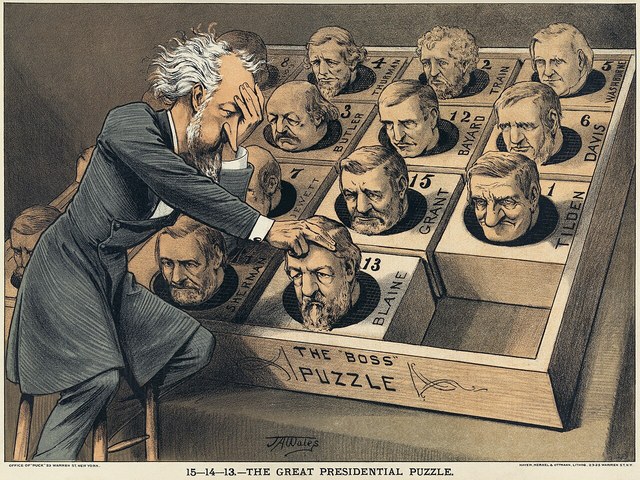
Stalwart Republicans

Stalwart Republicans
Mayer, Merkel, & Ottmann: lithographers br James Albert Wale · Public domain

Republican Party faction · 1870s–1880s · New York

Stalwart Republicans were a New York-based Republican faction led by Roscoe Conkling that championed the spoils system and opposed civil service reform.

The kit

  • Rise — Stalwart Republicans flexed political muscle by torpedoing A.T. Stewart's nomination as Treasury Secretary and supporting Grant for a third term through the Immortal 306.
  • Conflicts — Stalwart Republicans clashed with Rutherford Hayes over his firing of Chester Arthur as New York Customs House collector and opposed William Robertson's port appointment.
  • Achievements — Stalwart Republicans engineered a huge assessment producing $135,000 benefit in the moiety system for a Phelps, Dodge, and Company shipment.
  • Legacy — Stalwart Republicans were angered when Chester Arthur introduced civil service reform despite being part of their faction, which had opposed the Half-Breeds' reform efforts.

Runs with

York
based in New York and controlled patronage through the New York Customs House open card →
Republican Party
faction within the Republican Party during the late 19th century open card →
William
opposed William Robertson's appointment as port collector in New York open card →
Charles
assassin Charles Guiteau falsely claimed to be a Stalwart supporter open card →

The ladder · 9 clues

H

The assassin Charles Guiteau was a supporter of this Republican Party faction which favored the spoils system.

H

The leader of this political faction was the last individual who, after being confirmed, refused a seat on the Supreme Court.

H

A man from this group fought with Rutherford Hayes after Hayes fired the collector of the New York Customs House, Chester Arthur.

H

Members of this faction were behind the huge assessment of a shipment to Phelps, Dodge, and Company that produced a $135,000 benefit in the "moiety [[MOY-eh-tee]] system." The leader of this faction died while on a hopeless foot trek through Manhattan during the blizzard of 1888.

M

Roscoe Conkling was a member of this faction which was opposed to the Half-Breeds.

M

This faction of the Republican Party supported Grant and championed the spoils system. Charles Guiteau was a self-proclaimed member of this faction, which opposed the Half-Breeds.

M

This group’s Thomas Platt encouraged Ulysses S. Grant to run for a third term.

E

Roscoe Conkling served as leader of this group, which fought to prevent the breakup of the spoils system. name this Republican group based in New York whose rival faction was the Half-Breeds.

E

Arthur’s introduction of civil service reform angered many in this faction of the Republican Party, of which he was a part. This faction was led by Roscoe Conkling and opposed by the Half-Breeds.

10 more clues from the record
H

One of the first times this group flexed its political muscle was when it torpedoed A.T. Stewart’s nomination as Treasury Secretary.

H

The appointment of William Robertson to a port collector position in New York earned the ire of this faction.

H

This group included the Immortal 306, which would back their president at every turn.

H

Prominent opponents of this faction included Carl Schurz and William Robertson.

H

That leader of this faction had served as Thaddeus Stevens's bodyguard in the House.

H

Two Senators from this political faction resigned to protest the violation of a patronage deal known as the "Treaty of Fifth Avenue." One member of this faction was nicknamed “Me Too" and later became a political boss who united the five boroughs of New York into a single city to increase his power.

H

Name these things about a political group, FTP each:The Republican party near the end of the 19th century was divided into two factions. This one favored patronage, thus opposing civil service reform, unlike their counterparts the Half-Breeds.

H

That member of this faction was ridiculed for his “haughty disdain” and “turkey-gobbler strut,” and had earlier declared that the president had “treacherously betrayed a sacred trust” when he nominated Judge William Robertson to a certain position.

H

A member of this group gave a dramatic nominating speech that featured him leaping on the reporter’s table and sucking a lemon.

H

A leader of this group had an afair with Kate Sprague, and was reportedly chased out of her home with a gun by her husband.

Watch out: Charles Guiteau claimed to be a Stalwart but was not an actual member of the faction
#772 · US Political Parties and Factions · Level 2

Anti-Masonic Party

Anti-Masonic Party
Public domain

American third party · 1828–1838 · United States

Anti-Masonic Party was America's first significant third party, formed after William Morgan's 1826 disappearance and opposing Freemasonry.

The kit

  • Rise — Anti-Masonic Party grew in popularity after William Morgan's alleged killing by Freemasons on the Niagara River in 1826.
  • Achievements — Anti-Masonic Party held the first presidential nominating convention in 1831, subsequently nominating William Wirt for president in 1832.
  • Electoral success — Anti-Masonic Party won Vermont's electoral votes in 1832 and controlled governorships in Vermont under William Palmer and Pennsylvania under Joseph Ritner.
  • Legacy — Anti-Masonic Party eventually merged with the Whig Party and counted future president Millard Fillmore among its members.

Runs with

William
William Wirt was the party's 1832 presidential nominee open card →
Vermont
Vermont gave its electoral votes to the party in 1832 open card →
York
Solomon Southwick ran unsuccessfully for New York governor in 1828 open card →
Solomon
Solomon Southwick was an early party leader and newspaper publisher open card →

The ladder · 9 clues

H

This political party was supported by the Albany Evening Journal, which was founded by Thurlow Weed.

H

This party’s presidential nominee despairingly called his supporters a “motley crew” and its leadership refused to let him drop out of the race months before the election.

H

Solomon Southwick was this party’s unsuccessful nominee for Governor of New York in 1828, and it grew in popularity after William Morgan’s alleged killing by a group on the Niagara River.

H

One member of this organization was defeated as the incumbent governor of Pennsylvania by David Porter, a result which sparked the Buckshot War, started by partisans of Joseph Ritner.

M

In response to the mysterious disappearance of William Morgan, Thurlow Weed co-founded this party, which he used to oppose the Albany Regency.

M

This party held the first presidential nominating convention; it chose William Wirt, who won Vermont’s electoral votes in 1832.

M

At its height, the Vermont governorship was held by this party’s William Palmer.

E

This party held the nation's first convention to nominate a presidential candidate and subsequently nominated William Wirt in 1832.

E

This earliest 3rd party in the U.S. nominated William Wirt for President in the 1832 election. name this single-issue party that eventually merged with the Whig Party and opposed a certain secret society.

10 more clues from the record
H

Its presidential ticket, consisting of Amos Ellmaker and William Wirt, received seven electoral votes in the 1832 election. It was formed in reaction to the disappearance of William Morgan.

H

Another one of their candidates for higher office in a later incarnation was the first president of Wheaton College, Jonathan Blanchard.

H

After this party took over the Rhode Island legislature, it passed a state law banning any type of oath or obligation made outside a courtroom.

H

While serving in the New York State Assembly and Senate, both Millard Fillmore and William Seward were members of this party, which nominated William Wirt for the presidency.

H

Solomon Southwick’s National Observer was a newspaper for this party, whose loss in an 1828 New York election started a rivalry with the Democratic-Republicans.

H

John W. Phelps ran on this party’s ticket in the 1880 Presidential election, but received just over 1,000 votes.

H

State lottery organizer Solomon Southwick was a leader of this party, the original one backed by the Enquirer newspaper of Thurlow Weed.

H

Under the banner of this party, Pennsylvania's Joseph Ritner and Vermont's William Palmer both served gubernatorial terms.

H

Answer the following about a third party per part.The first-ever political nominating convention was held in 1831 by this party opposed to the re-election of Andrew Jackson, among other things.

H

People who didn’t vote for either of the two big parties generally went for this first major U.S. third party, a single-issue party that was strongest in states with weak opposition.

Watch out: William Wirt called his supporters a 'motley crew' and tried to drop out before the 1832 election
#1279 · Named Political and Social Movements · Level 3

Copperheads

Copperheads
Public domain

anti-war Northern Democrats · 1861–1865 · Northern United States

Copperheads were Northern Democrats who opposed the Civil War and advocated immediate peace with the Confederacy during 1861–1865.

The kit

  • Rise — Copperheads gained their pejorative snake nickname for criticizing the war effort and calling for Washington to give in to Confederate demands.
  • Conflicts — Copperheads clashed with Union authorities when General Ambrose Burnside issued Order Number 38, making it a crime to criticize the Civil War in Ohio.
  • Achievements — Copperheads included prominent leaders like Clement Vallandigham, who headed the Knights of the Golden Circle and defied military orders.
  • Legacy — Copperheads' hopes for the 1864 presidential election were crushed when Sherman captured Atlanta in September 1864.

Runs with

Ohio
Burnside's Order 38 targeted Copperheads in Ohio open card →
George
George E. Pugh was an Ohio Copperhead senator open card →
Pennsylvania
Edward G. Roddy promoted Copperhead ideas in Pennsylvania's Genius of Liberty open card →
Indiana
Copperheads plotted to overthrow Indiana's state government open card →

The ladder · 6 clues

H

The Pratt Street Riot was sparked by an angry mob composed of a faction of anti-war Democrats given this name.

H

Clement Vallandigham was perhaps the most prominent member of the group of anti-war northerners who were given this pejorative nickname.

M

An editor who spoke for this group opined that one president was "Fungus from the corrupt womb of bigotry and fanaticism." Soldiers clashed with this group in the 1864 Charleston Riot in Illinois.

M

A presidential letter written to Matthew Birchard concerned a leader of this group who headed the Knights of the Golden Circle and was defended by George Pugh for violating General Order number 38.

E

Order Number 38 was used to punish members of this group including Lambdin Milligan and Clement Vallandigham, both part of the Knights of the Golden Circle. name this group of "Peace Democrats" who opposed the Civil War.

E

Sherman's capture of Atlanta crushed their chances of winning the 1864 presidential election. name these conservative, anti-war Democrats who called for Washington to give in to Confederate demands.

10 more clues from the record
H

George E. Pugh was an Ohio senator from this group, as was Congressman Alexander Long.

H

Another member of this group plotted to seize the arsenal in Indianapolis and overthrow the Indiana state government; that plot led to David Davis writing an opinion that martial law has no jurisdiction in areas with functional civil courts in an ex Parte case involving another member.

H

Clement Vallandigham, a leader of this political faction, died after shooting himself in in the stomach in court while trying to prove that the person his client was accusing had accidentally shot himself in the stomach. :Identify this faction of northern Democrats in the Union who opposed the Civil War.

H

The subject of a namesake Harold Frederic novel, their members included Daniel Vorhees and Edward G. Roddy, who promoted their ideas in the Pennsylvania newspaper The Genius of Liberty.

H

In 2016, this specific animal’s name was given to a newly discovered spaceship in Conway’s Game of Life that is only 28 cells and is the first to move at a speed of c over ten.

H

Another prominent member of this group conspired with William Bowles, Joshua Bullitt, and others to seize Johnson’s Island and Camp Chase and was condemned to death.

H

Not everyone in the North was against the Confederacy during the Civil War. :Indiana senator Daniel Voorhees was a member of this group of Democrats opposed to the Civil War that was named after a snake.

H

Vallandigham belonged to this faction of the Democrats, along with Alexander Long. This faction, named after a type of snake, pushed for an immediate peace during the American Civil War.

H

This criticism prompted General Ambrose Burnside’s Order Number 38, which made it a crime in Ohio to criticize the Civil War in any way.

H

One member of this group, Nelson Wells, shot at Oliver Sallee in what some accounts claim instigated the Charleston Riot.

Watch out: Knights of the Golden Circle (secret society some Copperheads belonged to, not synonymous with Copperheads)