The 1648 Codex · study package

US Vice Presidents

3 terms drawn from across the corpus, in study-list order. Art and cross-links point back to the home category cards.

#165 · US Congressional Figures · Level 1

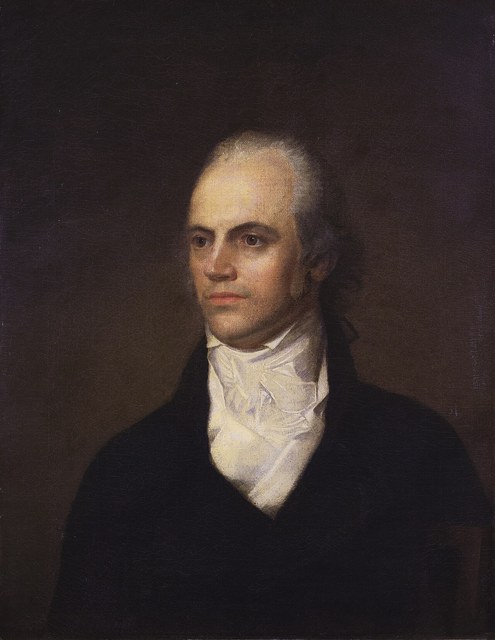
Aaron Burr

Aaron Burr
John Vanderlyn · Public domain

American politician · 1756–1836 · New York, Louisiana

Aaron Burr was Thomas Jefferson's first Vice President who killed Alexander Hamilton in an 1804 duel at Weehawken, New Jersey.

The kit

  • Rise — Aaron Burr won election to the Senate after building a coalition against Philip Schuyler and transformed Tammany Hall into a political machine.
  • Vice Presidency — Aaron Burr presided over the impeachment of Samuel Chase and oversaw the Senate's elimination of speaking limits as Vice President.
  • Duel — Aaron Burr shot and killed Alexander Hamilton in an 1804 duel at Weehawken, New Jersey, after Hamilton insulted him during an election.
  • Treason trial — Aaron Burr was tried for treason in 1807 after James Wilkinson exposed his plot to seize Louisiana territory, but John Marshall found him not guilty.

Runs with

Alexander Hamilton
killed him in 1804 duel at Weehawken open card →
James Wilkinson
Thomas Jefferson
served as his first Vice President open card →
New Jersey
site of his duel with Hamilton open card →

The ladder · 15 clues

H

This man lost the governorship of New York to the then unknown Morgan Lewis, in part due to former governor George Clinton campaigning against him.

H

This man was behind the Tammany Society’s initial transition from a social organization to a political machine, and he presided over the impeachment of Samuel Chase as Vice President.

H

This man leased the Bastrop Tract in Louisiana and Arkansas for a militia he was developing to attack colonial Spanish territory.

H

An expedition led by this man created a base of operations on Harman Blennerhassett’s island in the Ohio River.

H

This man asked Anthony Merry for help in obtaining the land from the Mississippi and Ohio Valleys as part of an anti-government scheme for which he was found not guilty by John Marshall.

H

This man refused to acknowledge that abolitionist John Pierre was his illegitimate son with his East Indian servant, Mary Emmons.

H

This man transformed Tammany Hall from a “speech-making club” into a political machine for anti-federalists.

M

This man’s daughter died aboard the schooner Patriot during the War of 1812 and was married to the then-Governor of South Carolina.

M

This New York lawyer received the second-highest amount of votes in one election, resulting in this man becoming vice president. name this early leader of the Democratic- Republicans, the vice president under Thomas Jefferson.

M

This man was arrested after being betrayed by James Wilkinson.

M

This man won election to the Senate after building a coalition against Philip Schuyler.

M

In an 1807 trial presided over by John Marshall, this man’s lawyers were allowed to subpoena Thomas Jefferson, whom this man had earlier served as Vice President. name this politician who was tried for treason after allegedly trying to seize land in Louisiana.

E

Thomas Jefferson’s first Vice President was this man who gained infamy at Weehawken, New Jersey when he killed Alexander Hamilton in a duel.

E

(1) Shot and killed Alexander Hamilton in an 1804 duel.

E

In Weehawken, New Jersey, this figure gunned down his political rival Alexander Hamilton. name this Vice President of Thomas Jefferson.

10 more clues from the record
H

Two men working under this person were charged of treason in the case of Ex parte Bollman.

H

James Wilkinson exposed this man’s plot to lodge war against Mexico and seize part of the Louisiana Purchase.

H

Charles James Fox discovered this politician’s attempt to gain support from British diplomat Anthony Merry.

H

This man conspired with James Wilkinson in an attempt to conquer Spanish territories and rule over a new empire, leading to a scandalous 1807 treason trial.

H

William Van Ness delivered a series of letters to a man who insulted this politician at a dinner party during an election against Morgan Lewis.

H

This man was arrested for, but not convicted of, treason after he was involved in a plot to create another country in the American West.

H

This man’s daughter disappeared and was never seen again while travelling aboard the ship Patriot.

H

This politician was accused of taking bribes from the Holland Land Company by John Barker Church.

H

As Vice President, this man oversaw the Senate’s elimination of speaking limits and the impeachment of Supreme Court Justice Samuel Chase for partisan opinions.

H

In preparation for one event, this man storied supplies at Blennerhassett Island but was betrayed by possible Spanish double agent James Wilkinson.
Watch out: His daughter Theodosia, not Aaron Burr himself, disappeared aboard the Patriot
#168 · US Congressional Figures · Level 1

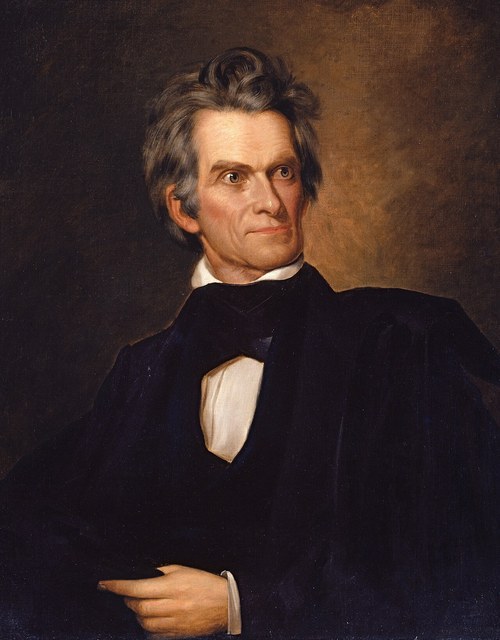
John C. Calhoun

John C. Calhoun
bdi George Peter Alexander Healy /span /a · Public domain

South Carolina politician · 1782–1850 · South Carolina, Washington D.C.

John C. Calhoun served as Vice President under both John Quincy Adams and Andrew Jackson, championing states' rights and nullification theory.

The kit

  • Rise — John C. Calhoun served as Secretary of War under James Monroe, creating the Bureau of Indian Affairs in that role.
  • Achievements — John C. Calhoun outlined his theory of "concurrent majority" in his Disquisition on Government to protect minority interests.
  • Conflicts — John C. Calhoun resigned as Andrew Jackson's Vice President to defend nullification in Congress after the Tariff of 1828 crisis.
  • Legacy — John C. Calhoun declared slavery a "positive good" in an 1837 Senate speech, shaping Southern pro-slavery ideology.

Runs with

South Carolina
represented South Carolina in Senate open card →
Nullification
developed nullification theory in Exposition and Protest open card →
Andrew Jackson
served as his Vice President, resigned over nullification open card →
Tariff of Abominations
called it unconstitutional in Exposition and Protest open card →

The ladder · 15 clues

H

This man replaced Abel Upshur after the USS Princeton incident, and as James Monroe’s Secretary of War, he created the Bureau of Indian Affairs.

H

This man accidentally sunk John Tyler’s attempts to annex Texas after a letter to Richard Pakenham hoping for the expansion of slavery was exposed.

H

James Madison vetoed this man’s proposed 1817 Bonus Bill.

H

In his A Disquisition on Government, this man outlined his belief of “concurrent majority” as a way to protect the subjugated South.

H

This politician criticized the United Kingdom for pushing abolition in Texas in a letter written to British ambassador Richard Pakenham.

H

He introduced the declaration of war against Britain on the floor of the Senate in 1812. :Identify this, a Vice President under Andrew Jackson and John Quincy Adams and States’ rights activist.

H

This man served as the Secretary of State for one year at the end of the John Tyler administration.

M

This politician explained his views of federalism in his Disquisition on Government, and he described slavery as a “positive good.” He succeed Abel Upshur, who was killed in the USS Princeton explosion, as Secretary of State under John Tyler. name this South Carolina politician who served as Vice President for John Quincy Adams and Andrew Jackson who supported nullification.

M

This man, who became Secretary of State after the USS Princeton disaster, declared slavery to be a “positive good” in an 1837 Senate speech.

M

His wife, Floride, organized Cabinet wives against Peggy Eaton in the Petticoat Affair during the Jackson presidency.

M

This figure and his wife, Floride, orchestrated the Peggy Eaton Affair, ostracizing the title woman for marrying too quickly.

M

Peggy Eaton was ostracized by Floride (Florida), the wife of this South Carolina politician who resigned as Jackson's Vice President.

E

This man resigned as Andrew Jackson’s vice president so that he could defend the right of nullification in Congress. name this influential senator from South Carolina.

E

In his “Exposition and Protest” this man stated that the Tariff of 1828 was unconstitutional.

E

Nullification was developed by this South Carolina politician.

10 more clues from the record
H

During this man’s tenure as Secretary of War under James Monroe he called for the censure and trial of Andrew Jackson due to his capture of Spanish Florida.

H

This politician became Secretary of State after the explosion of one of the guns on the U.S.S. Princeton killed Abel P. Upshur.

H

This man noted that “a vast majority of mankind is entirely biased by motives of self-interest” while arguing in favor of a minority veto in his posthumous Disquisition on Government.

H

This first head of the Bureau of Indian Affairs faced an uproar when his wife Floride refused to speak with the adulterous wife of the Secretary of State, Peggy Eaton.

H

This man formulated a namesake doctrine which held that the federal government had not power to limit slavery as it deprived the people to their right to property.

H

In an address to the Senate, this man claimed that the gravest question, “How can the Union be preserved?”, could only be answered by the North, not the South.

H

This man resigned during his lame duck period after casting the most tie-breaking votes of any U.S. vice president.

H

This man railed against those who would use governmental power to pursue personal gain in his Disquisition on Government.

H

On his deathbed, Andrew Jackson regretted that he had not executed this man, his former Vice President, for treason.

H

This politician organized the Nashville Convention in reaction to the Compromise of 1850, discussing the possibility of Southern secession.

Watch out: Abel Upshur—Calhoun replaced him as Secretary of State after the USS Princeton explosion
#1778 · US Vice Presidents, Cabinet Secretaries, and Executive Officials · Level 3

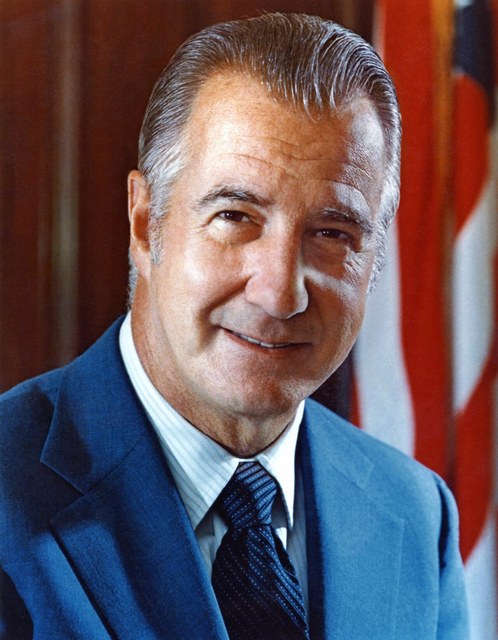
Spiro Agnew

Spiro Agnew
Seems to be his official VPOTUS portrait, and a small versio · Public domain

U.S. Vice President · 1969–1973 · Maryland, Washington D.C.

Spiro Agnew was Richard Nixon's first Vice President who resigned in 1973 over tax evasion and bribery charges unrelated to Watergate.

The kit

  • Rise — Spiro Agnew became executive of Baltimore County in 1962 and defeated segregationist George P. Mahoney in Maryland's 1966 gubernatorial race.
  • Achievements — Spiro Agnew attacked critics as "nattering nabobs of negativism" and called news broadcasters an "unelected elite" in speeches for Republicans.
  • Conflicts — Spiro Agnew was investigated for kickbacks from Maryland contractors totaling over $200,000 received while serving as governor and vice president.
  • Death & succession — Spiro Agnew's 1973 resignation triggered the first use of the Twenty-Fifth Amendment, leading to Gerald Ford's appointment as vice president.

Runs with

Maryland
served as Baltimore County executive and governor before vice presidency open card →
Richard Nixon
served as Nixon's first vice president from 1969 to 1973 open card →
Gerald Ford
Ford replaced him as vice president under Twenty-Fifth Amendment open card →
the Presidency
resigned the vice presidency in 1973 over corruption charges open card →

The ladder · 6 clues

H

One election win for this politician was aided by George Mahoney’s slogan of “Your home is your castle, protect it.” This man’s resignation led to the first application of Section 2 of the Twenty-Fifth Amendment.

H

Idaho Senator Len Jordan’s namesake rule was to vote the opposite way whenever this politician lobbied him to vote a certain way.

M

This man described his enemies as “hopeless, hysterical hypochondriacs of history” and “nattering nabobs of negativism” in an address to Republicans in San Diego.

M

Resigned in 1973 for tax evasion, after which he was replaced with Gerald Ford.

E

This first vice president of Nixon and former governor of Maryland resigned due to allegations of bribery unrelated to Watergate.

E

answer these questions about Richard Nixon’s presidency.Nixon’s first Vice- President was this Governor of Maryland who resigned due to tax evasion.

10 more clues from the record
H

This former governor defeated the segregationist George P. Mahoney in a 1966 gubernatorial election.

H

The Amendment was first invoked in 1973 when this Vice-President of Richard Nixon chose to resign after allegations of corruption were revealed from his time as Governor of Maryland.

H

He became executive of Baltimore County in 1962 on a graduated-tax platform and was elected governor of Maryland five years later.

H

In retirement from politics, this man wrote a bizarre novel about a conspiracy to destroy the United States, entitled The Canfield Decision.

H

This vice president defeated Sargent Shriver in his re-election campaign, though in 1968 he lost his home state of Maryland.

H

In the midst of the Watergate Scandal, a different scandal involving tax evasion caused the resignation of this Vice President.

H

This person borrowed $200,000 from Frank Sinatra after he left one post. :Name this Maryland governor who, after his stint in government ended, helped supply uniforms for Saddam Hussein and Nicolae Ceausescu. This vice president was investigated for kickbacks before his resignation.

H

Banzhaf’s Bandits, a few students from George Washington University, found enough people willing to make this man repay the over $200,000 he received in bribes as Governor of Maryland, but this isn’t the scandal most people associate him with.

H

During a riot, this politician called upon black leaders to “publicly repudiate black racists.” This man said news broadcasters represented an “unelected elite” who unfavorably subjected his party to instant criticism.

H

This real-world person wrote a novel about a cabal of traitorous Jewish lesbians instituting free love on the White House lawn to manipulate Porter Canfield’s ascension to the Presidency.

Watch out: Watergate scandal (Agnew's resignation involved separate tax evasion and bribery charges, not Watergate)