The 1648 Codex · study package

US Supreme Court Cases

14 terms drawn from across the corpus, in study-list order. Art and cross-links point back to the home category cards.

#531 · US Civil Rights Figures and Events · Level 2

Brown v. Board of Education
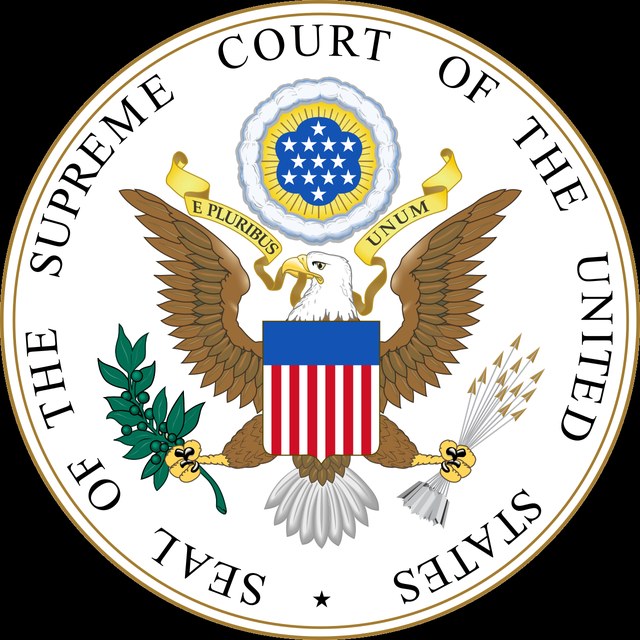
Brown v. Board of Education
b Original: /b /a /div Optimager /a /div Vector: /div Ipanko · Public domain

Supreme Court case · 1954 · United States

Brown v. Board of Education was the 1954 Supreme Court decision that unanimously declared racial segregation in public schools unconstitutional.

The kit

  • Ruling — Brown v. Board of Education overturned the "separate but equal" doctrine from Plessy v. Ferguson, mandating public school integration.
  • Evidence — Brown v. Board of Education relied heavily on Kenneth and Mamie Clark's doll experiments, demonstrating segregation's harmful psychological effects on children.
  • Implementation — Brown v. Board of Education's follow-up decision ordered desegregation to proceed "with all deliberate speed," a phrase from Francis Thompson's poem.
  • Resistance — Brown v. Board of Education sparked the massive resistance movement, including Harry Byrd's plan and necessitating Cooper v. Aaron to reaffirm judicial supremacy.

Runs with

Thurgood Marshall
argued Brown before the Supreme Court open card →
Separate but Equal
overturned this Plessy v. Ferguson doctrine open card →
Earl Warren
first major case of his Court open card →
William Rehnquist
wrote memo as clerk opposing the ruling open card →

The ladder · 9 clues

H

This Warren Court case was argued by Thurgood Marshall and overruled the "separate, but equal" doctrine of Plessy v.

H

This Supreme Court case was analogous to the Sweatt v.

H

Belton was one of the five cases combined into this case that reaffirmed the ruling in Bolling v Sharpe.

H

Those vouchers were part of Harry Byrd’s plan of “massive resistance” against this Supreme Court ruling, which was decided unanimously.

M

A follow-up decision to this case ruled that a process should begin “with all deliberate speed.” The final opinion in this case relied heavily on Kenneth and Mamie Clark’s “doll” study, showing the harmful effects a policy had on children. name this first major case of the Warren Court, a 1954 decision declaring public school segregation to be unconstitutional.

M

This case’s ruling, which was to be implemented with “all deliberate speed,” overturned the doctrine of “separate from equal” from Plessy v.

M

Elliot, which introduced experiments with children on reactions to different dolls, carried out by Kenneth and Mamie Clark.

E

Ferguson. name this 1954 case that declared “separate but equal” segregation of public schools unconstitutional.

E

This case’s second decision was ordered to be carried out with “all deliberate speed.” name this case that ruled against the concept of “separate but equal” in schools.

10 more clues from the record
H

The massive resistance movement began in response to this ruling, which was influenced by a series of doll tests carried out by Kenneth and Mamie Clark.

H

While clerking for Justice Jackson, William Rehnquist wrote a memo arguing [emphasize] against the eventual outcome of this case.

H

A follow-up to this case used a phrase from Francis Thompson's poem, "The Hound of Heaven." After 25 years, this case was reopened by Richard Jones and Charles Scott, Jr. Philip Elman claimed credit for the ruling in this case, and, as a clerk, William Rehnquist wrote a "random thought" on this case, decrying its outcome.

H

The Griffin case reinforced this legal decision, which was to be implemented “with all deliberate speed.” Evidence submitted for this case included Kenneth and Mamie Clark’s doll experiments.

H

In the aftermath of this case, the Supreme Court was forced to reaffirm judicial supremacy in Cooper v.

H

Ferguson, mandating the integration of public schools.

H

Felix Frankfurter requested a rehearing of this case, and this case was decided on the same day as Bolling v.

H

1924 election loser John W. Davis unsuccessfully argued a portion of this case that saw the Clark testimony, Briggs v.

H

Clarence Thomas claimed that this case’s ruling had been misunderstood by the courts in an opinion for Missouri v.

H

Because the District of Columbia was not subject to the Fourteenth Amendment, this case had to be extended in Bolling v.
Watch out: Bolling v. Sharpe (separate case extending Brown to Washington D.C., decided same day)
#536 · US Civil Rights Figures and Events · Level 2

Plessy v. Ferguson

Plessy v. Ferguson
b Original: /b /a /div Optimager /a /div Vector: /div Ipanko · Public domain

1896 Supreme Court case · 1896 · Louisiana

Plessy v. Ferguson established the 'separate but equal' doctrine, allowing racial segregation in public accommodations until Brown v. Board overturned it in 1954.

The kit

  • Background — Plessy v. Ferguson arose from a test case organized by a New Orleans citizens' committee challenging Louisiana's segregated train car law.
  • Plaintiff — Plessy v. Ferguson involved a one-eighth black man, represented by Albion Tourgée, who was arrested for riding in a whites-only car.
  • Decision — Plessy v. Ferguson's majority opinion, written by Henry Billings Brown, denied the existence of a 'badge of inferiority' in segregation.
  • Legacy — Plessy v. Ferguson served as precedent for cases like Pace v. Alabama and Cumming v. Rice, justifying racial segregation nationwide.

Runs with

Separate but Equal
established this doctrine in its majority opinion open card →
Louisiana
case challenged this state's train car segregation law open card →
William Rehnquist
wrote memo supporting this decision before Brown overturned it open card →
John Marshall

The ladder · 9 clues

H

Justice Harlan dissented in, what 1896 Supreme Court case that was overturned by Brown v.

H

One lawyer in this case wrote the newspaper column “A Bystander’s Notes,” calling for resistance against the central law in this case.

H

This case’s plaintiff was originally going to be musician Dan Desdunes [day-doon], but the state law in consideration did not apply to him.

H

David Josiah Brewer did not participate in this case’s decision on account of his daughter’s death.

M

William Rehnquist wrote a “Random Thought” supporting this decision two years prior to the 1954 case that would overturn it.

M

William Rehnquist affirmed this case’s outcome, whose majority opinion was written by Henry Billings Brown.

M

Samuel F. Phillips took part in this case, defending the plaintiff.

E

Board partially overturned this 1896 Supreme Court case, which developed the concept “separate but equal” accommodations.

E

Albion Tourgée [tour-zhay] represented the plaintiff of this case, a one-eighth black man sponsored by a New Orleans citizens' committee to ride in a whites-only train car. Name this 1896 case that established the "separate but equal" doctrine.

10 more clues from the record
H

The majority opinion in this case denied the existence of a “badge of inferiority.” Lum v.

H

This case was the subject of Otto Olsen’s book Thin Disguise, and the majority opinion referenced Roberts v.

H

Pace v. Alabama used this case as precedent in affirming Alabama's anti-miscegenation laws. :Name this Supreme Court case that arose from a test case aboard a Louisiana train car.

H

This case was preceded by the test trial of Daniel Desdunes , which was organized by Louis Martinet’s Comité des Citoyens.

H

One side in this trial was represented by Samuel Phillips who was opposed by Milton Joseph Cunningham, a man arrested during Reconstruction for restoring white supremacy.

H

Three years after it was decided, the verdict in this Supreme Court case was used to justify the closing of an educational facility in Richmond, Georgia in Cumming v.

H

Henry Billings Brown reasoned that the matters of “health, safety, and morals” belong to the state government in this majority decision for this case.

H

Albion W. Tourgée [[toor-ZHAY]] is said to have introduced the metaphor "color blind justice" while litigating this case.

H

Milton Joseph Cunningham prepared a legal brief for this case, which arose after Chris Cain arrested the plaintiff.

H

Rice applied this case to decide that a Mississippi public school was justified in denying a Chinese-American student.

Watch out: Justice Harlan dissented; Henry Billings Brown wrote the majority opinion
#540 · US Civil Rights Figures and Events · Level 2

Dred Scott v. Sandford

Dred Scott v. Sandford
b Original: /b /a /div Optimager /a /div Vector: /div Ipanko · Public domain

1857 Supreme Court case · 1857 · United States

Dred Scott v. Sandford ruled that African Americans could not be citizens and declared the Missouri Compromise unconstitutional.

The kit

  • Background — Dred Scott v. Sandford arose after the plaintiff traveled to Fort Armstrong in Illinois and Fort Snelling in Wisconsin with army surgeon John Emerson.
  • Ruling — Dred Scott v. Sandford held that African Americans were not citizens under the Constitution and therefore could not sue in federal court.
  • Missouri Compromise — Dred Scott v. Sandford declared the Missouri Compromise unconstitutional, ruling that living in free territory did not make a slave free.
  • Dissent & Legacy — Dred Scott v. Sandford drew dissents from John McLean and Benjamin Curtis, who cited the Northwest Ordinance as valid precedent.

Runs with

John
Army surgeon John Emerson owned Scott during travels to free territories open card →
Wisconsin
Scott lived at Fort Snelling in Wisconsin Territory with Emerson open card →
Missouri Compromise
Declared the Missouri Compromise unconstitutional in its ruling open card →
Illinois
Scott traveled to Fort Armstrong in Illinois with his owner open card →

The ladder · 9 clues

H

The Missouri Compromise was deemed unconstitutional by, what controversial 1857 Supreme Court case that determined slaves could not sue in court because they were not U.S. citizens?

H

This case revolved around the central figure’s travels to Fort Armstrong in Illinois and Fort Snelling in Wisconsin in the service of John Emerson.

H

In the precursor to this case, Samuel Russell’s testimony was ruled hearsay and he hired Samuel Bay.

H

John McLean and Benjamin Curtis dissented from the majority opinion in this case, citing a lack of opposition to similar provisions in the Northwest Ordinance.

M

Robert Cooper Grier was pressured by James Buchanan to side with the majority in this case.

M

In this landmark Supreme Court case, Taney ruled that African Americans, whether free or slave, were not citizens. The case is named after an African American who unsuccessfully sued for his freedom.

M

The plaintiff in this case, with Harriet Robinson, accompanied army surgeon John Robinson to the Wisconsin Territory.

E

The constitutionality of the Missouri Compromise was challenged by Roger Taney [TAW-nee] in this 1857 decision which ruled that its central figure “could not be an American citizen” because of the color of his skin. name this Supreme Court case dealing with a slave’s attempts to appeal for his freedom.

E

The Missouri Compromise was declared unconstitutional in this case and Roger Taney [TAW-nee] ruled that living in a free territory does not make a slave a free man. name this 1857 case which ruled that slaves are not citizens under the Constitution.

10 more clues from the record
H

name these court cases that have shaped American society.This 1857 case, that ruled that slaves were property and had no rights, began after a slave moved with his owner to a free territory and back.

H

Dissenting justice John McLean cited a provision in the Northwest Ordinance as a valid precedent for the law overturned in the majority decision of this case.

H

One justice in this case claimed that the founders had intended for a “perpetual and impassable barrier” between two groups.

H

This case ruled that certain laws did not apply at Fort Snelling despite the fact that the plaintiff had lived there with John Emerson.

H

The ruling in this case differentiated between national and state citizenship and used the Privileges and Immunities Clause to determine that the plaintiff could not sue.

H

The outcome of this Supreme Court case helped trigger an economic panic that included the failure of the Ohio Life Insurance and Trust Company.

H

The original defendant in this case was Irene Emerson, widow of an army doctor who moved from Missouri to Wisconsin.

H

After the ruling of this case, Calvin C. Chafee and Taylor Blow provided protection for the plaintiff.

H

The ruling in this case was criticized by Benjamin Curtis for striking down the Missouri Compromise.

H

This case's subject based his legal argument on precedents such as Winny v.

Watch out: Original defendant was Irene Emerson, not Dred Scott; case name reflects later appeal with John Sanford
#1091 · US Supreme Court Cases · Level 3

Marbury v. Madison

Marbury v. Madison
b Original: /b /a /div Optimager /a /div Vector: /div Ipanko · Public domain

1803 Supreme Court case · 1803 · United States

Marbury v. Madison established judicial review when the Supreme Court struck down part of the Judiciary Act of 1789.

The kit

  • Background — Marbury v. Madison arose when William Marbury requested a writ of mandamus after being denied his federal commission.
  • Midnight judges — Marbury v. Madison concerned a justice of the peace appointed by John Adams at the tail end of his administration.
  • Ruling — Marbury v. Madison declared section 13 of the Judiciary Act unconstitutional because it violated Article Three's original jurisdiction parameters.
  • Legacy — Marbury v. Madison established that determining what is constitutional is "emphatically the province and duty" of the judicial branch.

Runs with

John Adams
appointed Marbury as midnight judge open card →
John Marshall
wrote majority opinion establishing judicial review open card →
Secretary of StateWilliam

The ladder · 6 clues

H

The plaintiff in this Supreme Court case had asked for a writ of mandamus after the defendant refused to deliver a federal commission to him.

H

This case involved a justice of the peace of Washington, D.C.’s “midnight appointment” by John Adams.

M

The issue of the “midnight judges” led to this 1803 Supreme Court Case that struck down the Judiciary Act of 1789 and established the principle of judicial review.

M

The majority opinion in this case stated the court had no jurisdiction in mandamus proceedings, and declared section 13 of the Judiciary Act of 1789 unconstitutional.

E

The Judiciary Act was ruled unconstitutional by John Marshall in this case. name this 1803 Supreme Court case that created the process of judicial review.

E

This case concerned the appointment of "midnight judges" at the tail end of the administration of John Adams.

10 more clues from the record
H

Answer some questions about Chief Justice John Marshall .In what 1803 Supreme Court case did Marshall's Court establish the principle of judicial review? The case, which involved a Secretary of State, featured a judicial appointee who had been denied his commission.

H

During testimony in this case, former acting Secretary of State Levi Lincoln controversially requested time to consider whether he should answer any questions.

H

Jacob Wagner and Daniel Brent attempted to refuse to testify during this event.

H

This court case defined the difference between appellate jurisdiction and original jurisdiction.

H

Levi Lincoln helped cause this court case on behalf of a man that later rebuked the final decision by saying “you seem to consider judges the ultimate arbiters of all constitutional questions”.

H

The ruling in this case was compared to an “irresistible implication” in a later dissent by John Gibson, which formed the only memorable part of Eakin v.

H

This case, whose majority opinion cited Federalist Papers No. 78, began as a result of James Markham Marshall failing to deliver commissions prior to a presidential inauguration.

H

A quotation from the ruling in this case about what is "emphatically the province and duty" of a government body is now inscribed at the Supreme Court.

H

This case found that the Judiciary Act of 1789 contained provisions contrary to the original jurisdiction parameters of Article Three of the Constitution.

H

This case laid out the official terms of a policy that had begun seven years prior in Hylton v.

Watch out: Hylton v. U.S. began a policy seven years before this case
#1092 · US Supreme Court Cases · Level 3

Roe v. Wade

Roe v. Wade
b Original: /b /a /div Optimager /a /div Vector: /div Ipanko · Public domain

Supreme Court case · 1973 · United States

Roe v. Wade was a 1973 Supreme Court decision establishing constitutional protection for abortion rights under the Fourteenth Amendment's privacy guarantee.

The kit

  • Background — Roe v. Wade was argued by Sarah Weddington and Linda Coffee representing plaintiff Norma McCorvey under a pseudonym.
  • Legal basis — Roe v. Wade relied on privacy rights established in Griswold v. Connecticut and the Fourteenth Amendment's Due Process Clause.
  • Ruling — Roe v. Wade held that only a "compelling state interest" could override privacy rights, legalizing abortion until fetal viability.
  • Legacy — Roe v. Wade was overturned in Dobbs v. Jackson in June 2022, ending federal constitutional abortion protections.

Runs with

Abortion
Texas
challenged Texas statute restricting abortion open card →
James
Dr. James Hallford ruled to lack standing open card →
Griswold v. Connecticut
relied on privacy right established in Griswold open card →

The ladder · 6 clues

H

This challenge to a Texas statute had a companion case challenging a Georgia law filed on the same day called Doe v.

H

Sarah Weddington and Linda Coffee raised challenges that led to this case, in which Norma McCorvey was the plaintiff under a pseudonym.

M

This case was strengthened after the 2016 Hellerstedt case allowed for a bypass of "admitting privileges." This case was decided shortly after the conclusion of Younger v. Harris, giving Harry Blackmun time to solicit research from the Mayo Clinic in his majority opinion.

M

The right to privacy was also crucial in the majority opinion in this controversial 1973 case, which guaranteed a woman's right to abortion until viability.

E

Bolton and ruled in favor of Norma McCorvey, who later became a pro-life activist. name this 1973 Supreme Court case that legalized most abortions.

E

Casey decision. name this 1973 Supreme Court case which established that the right to privacy under the 14th Amendment covered a woman’s right to an abortion.

10 more clues from the record
H

The Hyde Amendment made shortly after this case was upheld in Harris v.

H

A joke about “two beautiful ladies” by the defendant fell flat during oral arguments in this case.

H

In this case, 26-year-old lawyer Sarah Weddington represented the plaintiff, later compiling her experiences in her book A Question of Choice.

H

Harry Blackmun wrote that only a “compelling state interest” was strong enough to overrule privacy rights after he spent time at Mayo Clinic to research this case.

H

An attorney on this case, Jay Floyd, was stared down by Warren Burger after making an offensive joke about two attorneys.

H

This case reached the Supreme Court after a longstanding doctrine of treating the topic as moot was rescinded, and it relied on a right established in Griswold v.

H

In addition to the main ruling, the court held that Dr. James Hallford did not have standing to sue.

H

In June 2022, Dobbs v. Jackson overturned this Supreme Court decision. :Name this 1973 landmark decision in which the Supreme Court ruled the The United States Constitution protects a woman’s right to an abortion.

H

Three years after this Supreme Court case was decided, Henry Hyde sponsored an amendment restricting how federal funds could be spent on its subject.

H

A paper by Donald Regan interprets the result of this court case to hold that people cannot be forced to become Good Samaritans.

Watch out: Doe v. Bolton was the companion case filed the same day challenging Georgia's abortion law
#1093 · US Supreme Court Cases · Level 3

Worcester v. Georgia

Worcester v. Georgia
a rel="nofollow" Internet Archive Book Images · No restrictions

1832 Supreme Court case · 1832 · United States

Worcester v. Georgia was an 1832 Supreme Court case ruling that state law did not apply within Cherokee territory.

The kit

  • Plaintiff — Worcester v. Georgia involved missionary Samuel Worcester, who co-founded the newspaper Phoenix with Elias Boudinot.
  • Ruling — Worcester v. Georgia saw Chief Justice John Marshall rule that only the federal government had the right to deal with Native American tribes.
  • Jackson's defiance — Worcester v. Georgia was ignored by Andrew Jackson, who reportedly said "John Marshall has made his decision, now let him enforce it!"
  • Outcome — Worcester v. Georgia failed to prevent Cherokee removal despite overturning the conviction of seven missionaries including Elizur Butler.

Runs with

Cherokee
ruled Georgia law had no force in Cherokee territory open card →
Andrew Jackson
refused to enforce the ruling open card →
John Marshall
wrote the majority opinion open card →
Native Americans
defended tribal sovereignty against state interference open card →

The ladder · 6 clues

H

Andrew Jackson ignored this 1832 Supreme Court case which defended the sovereignty of Native Americans against the states.

H

Wilson Lumpkin offered to give a pardon to a side involved in this court case.

M

This 1832 Supreme Court case ruled that state law did not apply to the Cherokee. Jackson’s refusal to enforce the ruling resulted in the Nullification Crisis.

M

Jackson showed his disrespect for Native Americans as well as his willingness to enforce quasi-dictatorial powers when he refused to enforce this Supreme Court decision protecting the Cherokee from complying with the directives of state governments.

M

Andrew Jackson flat-out ignored the ruling in this 1832 case, which recognized Indian nations as sovereign and prohibited a certain state’s attempt to redraw its border with the Cherokee.

E

The response, “John Marshall has made his decision, now let him enforce it!” followed this 1832 Supreme Court case which held that state governments, including the named defendant, could not interfere with the Cherokee Nation.

9 more clues from the record
H

This case overturned a state law that prohibited non-Native Americans from coming into contact with Natives on tribal land.

H

The plaintiff in this case co-founded the newspaper Phoenix with Elias Boudinot.

H

Governor George Gilmer withdrew one of its namesake's tenure as postmaster so that the state could prosecute him under a licensing law.Name this Supreme Court case that overturned the conviction of seven missionaries including Elizur Butler.

H

After retiring as attorney general, Wirt became an advocate of Cherokee rights, arguing this case before the Supreme Court. John Marshall ruled in favor of the Cherokee as an independent nation, but Andrew Jackson just ignored him.

H

That plaintiff argued that the actions of a state government violated Article I, Section 8 of the Constitution, an argument which found favor with six of seven justices, who held that the territory in question was a "distinct community" in which the laws of the state held no force.

H

The missionary plaintiff in this case was initially released when he claimed that he operated under federal authority as the postmaster of New Echota, but was relieved of his duties and rearrested.

H

The Cherokee were removed despite the ruling of this 1832 court case. This court case, which was levied against Georgia, found that the state had no place in Native affairs.

H

The ruling Jackson was responding to was this one, which ruled a state's law prohibiting non-Indians being on Indian land unconstitutional.

M

This Supreme Court case saw Chief Justice John Marshall rule that only the federal government had the right to deal with Native American tribes.

#1094 · US Supreme Court Cases · Level 3

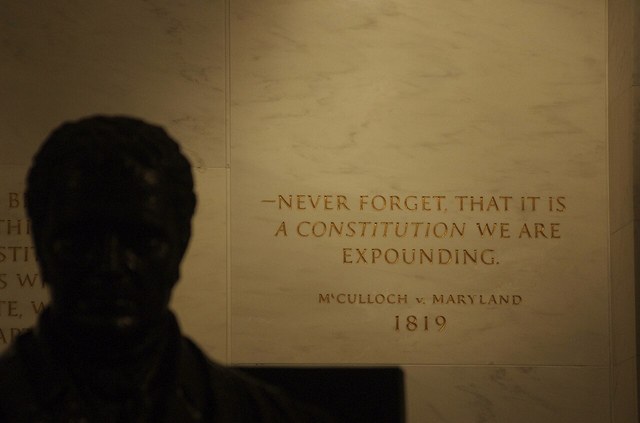
McCulloch v. Maryland

McCulloch v. Maryland
a rel="nofollow" swatjester · CC BY-SA 2.0

1819 Supreme Court case · 1819 · United States

McCulloch v. Maryland was an 1819 Supreme Court case that struck down Maryland's tax on the Second Bank of the United States.

The kit

  • Rise — McCulloch v. Maryland arose when Baltimore financier James McCulloch refused to pay Maryland's tax on out-of-state banks.
  • Achievements — McCulloch v. Maryland established that Congress has implied powers to enforce the Constitution's express powers through necessary and proper means.
  • Achievements — McCulloch v. Maryland ruled that the power to tax is the power to destroy, preventing states from taxing federal institutions.
  • Legacy — McCulloch v. Maryland was cited as precedent in D'Emden v. Pedder, the first major case of Australia's High Court.

Runs with

Bank
established federal authority to create banks via implied powers open card →
Second Bank of the United States
protected the Bank from Maryland's taxation attempt open card →
Daniel Webster
Maryland
the state whose tax on federal banks was struck down open card →

The ladder · 6 clues

H

1819 court case which concerned Maryland's attempt to tax the Second Bank of the United States.

H

A state could not tax the Second Bank of the U.S. in what 1819 Supreme Court case?

M

The ruling in this case argued that the Necessary and Proper Clause provided the federal government the right to establish the Second Bank of the United States. name this case in which a Baltimore financier refused to pay a tax on out-of-state banks.

M

In this case, a rejection of the narrow interpretation of the word “necessary” by John Marshall led to a balance between federal and state powers.

E

This case claimed that the power to tax is the power to destroy, in striking down a specific tax. name this case that found that a certain state couldn’t tax the Bank of the United States.

E

The representative of the namesake Mid-Atlantic state in this case, which sought to impose a tax on a federal institution, argued that the “Constitution is silent on the subject of banks." name this 1819 case argued by Daniel Webster, who represented the Second Bank of the U.S.

10 more clues from the record
H

This was the first Supreme Court case to make official Alexander Hamilton’s concept of the implied powers of the Constitution.

H

This case established that Congress’ implied powers could enforce the Constitution’s express powers.

H

The ruling in this case overruled an appelate ruling that found that the “Constitution is silent on the subject,” thereby protecting the implied power of Congress to carry out constitutional laws by “necessary and proper” means.

H

The word “expressly” greatly affected this case’s ruling, which established the implied powers of Congress to enforce expressed powers, citing Hamilton’s criteria.

H

In the Australian case D’Emden v Pedder, Attorney General James Drake referenced this American court case, which arose from a lawsuit John James filed.

H

This case’s definition of laws that allow for the “beneficial exercise” of other laws was applied by the Supreme Court in the 2010 case U.S. v.

H

This U.S. case was cited as a primary example in the first major case overseen by the High Court of Australia, D'Emden v.

H

Pedder, which helped flesh out the Australian Constitution.

H

This case was used as precedent during D’Emden v.

H

The authority of the bank was challenged by the state of Maryland in this 1819 Supreme Court Case. It ruled that the federal government has the right to establish a national bank.

Watch out: Students may confuse this with other early Marshall Court cases establishing federal supremacy, such as Gibbons v. Ogden
#1095 · US Supreme Court Cases · Level 3

Gibbons v. Ogden

Gibbons v. Ogden
p White, Emma Siggins, b. 1857; /p Maltby, Martha Humphreys · No restrictions

Supreme Court case · 1824 · United States

Gibbons v. Ogden upheld Congress's right to regulate interstate commerce, breaking New York's steamboat monopoly.

The kit

  • Background — Gibbons v. Ogden arose after New York's Court of Chancery issued an injunction against a company operating from Elizabethtown.
  • Monopoly dispute — Gibbons v. Ogden challenged Robert Livingston and Robert Fulton's monopoly on New York navigation granted by state law.
  • Constitutional interpretation — Gibbons v. Ogden interpreted the word "among" as "intermingled with" regarding Congress's commerce power in Article I, Section 8.
  • Outcome — Gibbons v. Ogden established the federal government's sole ability to decide matters of interstate commerce including navigation.

Runs with

John Marshall
Marshall wrote the opinion interpreting Article I, Section 8 open card →
Cornelius Vanderbilt
Vanderbilt captained the ship for appellant Gibbons open card →
York
New York state granted the monopoly struck down open card →
New York City
route ran from Elizabethtown to New York City open card →

The ladder · 6 clues

H

Congress's right to regulate interstate commerce was upheld in this 19th century court case.

H

In this case, Attorney General William Wirt argued that the federal patent preemptively applied for by the plaintiff superseded any regulation from the state.

M

Cornelius Vanderbilt worked as a captain for the appellant in this case who was sued over a route from Elizabethtown to New York City.

M

In this case, the word “among” was interpreted as “intermingled with” in regards to regulation.

E

1824 case that ruled that New York could not regulate steamboat navigation on its waters because it was interstate commerce.

E

Robert Livingston and Robert Fulton’s monopoly on New York navigation resulted in this case that established the federal government’s sole ability to decide on matters of interstate commerce.

10 more clues from the record
H

Vanderbilt captained the ship at the center of this Supreme Court case, which held that Congress’s power over interstate commerce extended to navigation.

H

John Marshall found that the word “among” in Article I, Section 8 of the Constitution was central to the decision of this case, which came about after one state’s Court of Chancery issued an injunction against a company operating out of Elizabethtown.

H

One namesake of this court case was represented by Samuel Southard and a member of the United Irishmen, Thomas Addis Emmet.

H

In this author’s autobiography, he described suffering shrapnel wounds to the lung duRring the Battle of Somme while a member of the Royal Welsh Fusiliers.

H

William Wirt helped argue this case, which included a ship owner who hired Cornelius Vanderbilt to run a ferry.

H

The primary attorney of the defendent in this case, Thomas Addis Emmet, previously served as barrister for the revolutionary Society of the United Irishmen.

H

Elizabethtown was one terminus of the industry at the center of this court case, one of whose employees was a young Cornelius Vanderbilt.

H

Stiffel, which questioned whether patent law was sufficient to resolve its question.

H

In this 1824 case, Vanderbilt’s employer won rights to operate his steamboats in the Hudson River, while the federal government broke a ferry monopoly by two other owners issued by the state of New York.

H

The act under review granted rights to John Fitch and then transferred the privilege to Robert Livingston, who licensed another man to run between Elizabeth Point and New York City.

#1096 · US Supreme Court Cases · Level 1

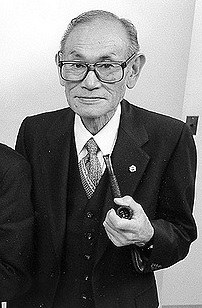
Korematsu v. United States

Korematsu v. United States
Image courtesy of the family of Fred T. Korematsu · CC BY 2.0

Supreme Court case · 1944 · United States

Korematsu v. United States was a 1944 Supreme Court case that upheld the constitutionality of Japanese-American internment during World War II.

The kit

  • Decision — Korematsu v. United States ruled 6-3 that national security needs trumped individual rights, with Hugo Black writing the majority opinion.
  • Legal impact — Korematsu v. United States established the strict scrutiny test for racial issues that would later be used against segregation.
  • Dissents — Korematsu v. United States featured dissents by Frank Murphy, who first used "racism" in a Supreme Court opinion, and Robert Jackson warning of a "loaded weapon."
  • Later reversal — Korematsu v. United States was overturned in 1983 after Dale Minami filed a coram nobis writ, though it has not been officially overruled by the Supreme Court.

Runs with

Charles
Charles Fahy suppressed naval intelligence evidence open card →
Japanese-American Internment
upheld constitutionality of Executive Order 9066 open card →
John
John Roberts repudiated it in Trump v. Hawaii open card →
World War II
wartime detention case during WWII open card →

The ladder · 15 clues

H

The dissenting opinion in this case noted “precedent lies like an open weapon in the hand that can bring a plausible claim for an urgent need” and notes how the plaintiff was given two contradictory orders: one to stay in one place, and one to evacuate.

H

Charles Fahy was accused of suppressing evidence in this case by hiding a report from naval intelligence.

H

Justice Frank Murphy’s dissent in this case, along with his concurrence in Steele, marked the first uses of the word “racism” in a Supreme Court opinion.

H

Name these discrimination cases in Supreme Court history, .Frank Murphy made a vociferous dissent to this 1944 ruling, in which the majority upheld FDR's racially based Civilian Exclusion Order Number 34.

H

Robert Jackson’s dissent in this case noted that the central figure was “born on our soil” and that the central law would have been indefensible in less uncertain times.

H

As Acting Solicitor General, Neal Katyal released a 2011 statement accusing one of his predecessors, Charles Fahy, of covering up evidence relevant to this case.

H

Frank Murphy's dissent in this case noted "all residents of this nation are kin" and denounced the "the ugly abyss" of discrimination on display.

M

John Roberts specifically repudiated the decision made during this court case by the Harlan Stone-led court in the decision of the 2018 case Trump v.

M

This 1944 Supreme Court decision concerning interned Japanese-Americans during World War II was the first case to withstand strict scrutiny.

M

This case has controversially not been officially overturned.

M

Hugo Black wrote the majority opinion for this 1944 Supreme Court case, which upheld the constitutionality of Japanese internment camps and involved an Oakland man who refused to report to one.

M

This wartime case upheld Japanese internment but established the strict scrutiny test for racial issues that would be later used against segregation.

E

United States. name this controversial 1944 Supreme Court case that upheld the legality of Japanese-American internment.

E

This case, which dealt with the legality of Executive Order 9066, was preceded by Hiribayashi v.

E

Upheld the internment of Japanese-Americans?

10 more clues from the record
H

This case's plaintiff had been recently fired as a welder and had been denied admission into the service because of ulcers.

H

The plaintiff in this case underwent plastic surgery and changed his name to Clyde Sarah.

H

In his concurrence with this case’s decision, Felix Frankfurter cited Hamilton v.

H

In his dissent of this case, Justice Jackson stated that allowing wartime detention based on Japanese ethnicity would be a “loaded weapon” for an authority that can plausibly argue that a need exists for it to be used. :Name this 1944 case which affirmed the consitutionality of internment camps.

H

This Supreme Court case ruled that Japanese Internment was constitutional because it was necessary to remove threats and it was impracticable to separate, “the disloyal from the loyal.” This case is still accepted precedent, though it is viewed with suspicion by most jurists.

H

Japanese internment was unsuccessfully challenged in this 1944 court case. In a 6-3 decision, the Supreme Court ruled that the need for national security trumped the plaintiff’s individual rights.

H

This ruling was overturned by a federal court in 1983 after the plaintiff, who was working as a florist upon his arrest, appealed his original conviction on new grounds.

H

Dale Minami led a group of lawyers that sought to correct this decision by filing a coram nobis writ that Judge Patel certified.

H

Hugo Black’s majority opinion in this case drew upon an earlier case that involved a university student accused of violating a curfew.

H

Ruth Bader Ginsberg cited the odiousness of this other court case in her concurring opinion for the court case Adarand Constructors v.

Watch out: Hirabayashi v. United States (earlier curfew case involving a university student that Black's majority opinion drew upon)
#1097 · US Supreme Court Cases · Level 3

Lochner v. New York

Lochner v. New York
Michael Reschke · CC BY-SA 3.0

1905 Supreme Court case · 1905 · United States

Lochner v. New York struck down a New York law limiting bakers' working hours, establishing a constitutional 'liberty of contract.'

The kit

  • Constitutional basis — Lochner v. New York held that 'liberty of contract' was implicit in the Fourteenth Amendment's due process clause.
  • Majority opinion — Lochner v. New York's majority opinion by Rufus Peckham claimed baking had never been regarded as an unhealthy trade.
  • Holmes dissent — Lochner v. New York prompted Oliver Wendell Holmes to dissent that 'The Fourteenth Amendment does not enact Mr. Herbert Spencer's Social Statics.'
  • Legacy — Lochner v. New York began a forty-year era of Supreme Court opposition to economic regulation, ending with West Coast Hotel v. Parrish.

Runs with

York
struck down New York state law open card →
Fourteenth Amendment
found liberty of contract implicit in due process clause open card →
Louisiana
Henry
defendant represented by Henry Weismann open card →

The ladder · 6 clues

H

Parrish ended a forty-year era named for this case in which the Supreme Court consistently sided against economic regulation. name this 1905 Supreme Court case that cited due process in overturning a law limiting the work hours of bakers in New York.

H

The plaintiff in this case hired attorney Henry Weismann, who described locations as "well ventilated" and "always sweet smelling." The majority opinion in this case claimed a certain trade "has never been regarded as an unhealthy one" and was written by Rufus Peckham.

M

This case held that a “liberty of contract” was implicit in the Fourteenth Amendment after a New York bakery tried to regulate its bakers’ working hours.

M

Louisiana by Rufus Peckham, who cited usury laws in the majority decision for this case.

E

A dissent in this case insisted that the "Fourteenth Amendment does not enact Mr. Herbert Spencer's Social Statics." name this 1905 Supreme Court case defending "liberty of contract," which struck down a New York law limiting the number of hours a baker could work each day.

E

Parrish marked the end of a period named for this court case, in which Oliver Wendell Holmes wrote a dissent claiming, “The Fourteenth Amendment does not enact Mr. Herbert Spencer's Social Statics.” name this Supreme Court case arising from a state law capping the number of hours bakers could work.

10 more clues from the record
H

Guaranteed “liberty of contract” against state regulation and involved bakers’ working hours?

H

One brief in this case focused on the “lack of knowledge” of citizens and was written by Julius Mayer.

H

BONUS. Name these labor cases brought before the Supreme Court, .Justice Peckham wrote that a state law limiting the workweek of bakers violated the freedom of contract in this 1905 case.

H

In the majority opinion of this case, its author pre-empted a dissenting argument by claiming, “This is not a question of substituting the judgment of the court for that of the legislature.” The case West Coast Hotel v.

H

One dissent written in this case said that the word "liberty" was perverted when it was used to prevent the will of the majority and thought the judgment was contradicted by usury laws and injunctions against Sunday trading.

H

A dissent in this case cited the need for “a plain, palpable invasion of rights” to justify the “power of the courts to review legislative action.” Henry Weismann argued for the defendant in this case, which overturned the earlier ruling of Holden v.

H

Louisiana began this period, which ended when the Three Musketeers were joined by Owen Roberts in a case that upheld a minimum wage law, West Coast Hotel v.

H

This case’s decision lost influence with the “switch in time that saved nine” which ruled the government could restrict the liberty of contract in West Coast Hotel v.

H

In Harlan cited a plague in Marsailles in 1720 that wiped out all members of a certain profession to show that the work was unusually harsh.

H

In a case three years later, David Brewer claimed that his opinion only differed from this decision on the issue of sex, and this case was upheld in Adkins v.

Watch out: Lochner v. New York overturned the earlier ruling of Holden v. Louisiana, not the reverse
#1098 · US Supreme Court Cases · Level 1

Schenck v. United States

Schenck v. United States
Gottfried Anton Schenck /a · Public domain

1919 Supreme Court case · 1919 · United States

Schenck v. United States was a 1919 Supreme Court case that upheld the Espionage Act and established the "clear and present danger" test.

The kit

  • Background — Schenck v. United States arose when Socialist Party general secretary Charles Schenck distributed antiwar pamphlets urging draft resistance, violating the Espionage Act.
  • Decision — Schenck v. United States produced a unanimous opinion by Oliver Wendell Holmes Jr. introducing the "clear and present danger" test for limiting speech.
  • Legacy — Schenck v. United States introduced the famous analogy of "shouting fire in a crowded theater" to illustrate unprotected speech.
  • Reversal — Schenck v. United States was weakened by subsequent "bad tendency" tests and overturned fifty years later in Brandenburg v. Ohio.

Runs with

Ohio
Brandenburg v. Ohio overturned this case in 1969 open card →
Oliver Wendell Holmes Jr.
Holmes wrote the unanimous opinion establishing "clear and present danger" open card →
First Amendment
established limits on First Amendment free speech rights open card →
Common

The ladder · 15 clues

H

An Associate Justice of the Supreme Court used a standard set in this case to argue in favor of the defendant in Abrams v.

H

Case in which the “clear and present danger” doctrine was created to uphold the conviction of a Socialist antiwar organizer

H

The precedent established by this case was altered in the case whose dissent introduced the marketplace of ideas, Abrams v.

H

The standard in this case was limited in Whitney vs. California, which replaced it with the nebulous “bad tendency” standard.

H

Ohio possibly overturned this case, whose central figure worked with Elizabeth Baer to pass out documents with advice like “Do not submit to intimidation,” trying to obstruct the draft.

H

Because a standard set in this case was not met, Jacob Abrams lost his Supreme Court case eight months later.

H

A week after this case was decided, Jacob Frohwerk had his similar conviction upheld as well.

M

The results of this case were ultimately weakened by the "bad tendency" test introduced in Patterson v.

M

Fifty years later, this decision was overturned in the case of Brandenburg v.

M

Elizabeth Baer was originally tried alongside the plaintiff in this case, which paved the way for the ruling in Abrams v.

M

The defendant in this case was jailed for distributing documents which quoted the 13th Amendment before stating “Do not submit to intimidation.” A standard set by this case was superseded after Brandenburg v.

M

It arose when the general secretary for the Socialist party challenged his conviction for distributing pamphlets designed to obstruct the draft. what was this 1919 case in which Justice Holmes issued his famous opinion containing the “clear and present danger” test and the analogy to a person yelling fire in a theater?

E

The metaphor of “shouting fire in a crowded theater” was used in this 1919 Supreme Court case concerning the Espionage Act in which Oliver Wendell Holmes outlined the “clear and present danger” test.

E

The Rosenbergs were convicted under the Espionage Act, whose constitutionality was upheld by this 1919 Supreme Court case. In his decision on this case, Oliver Wendell Holmes introduced the concept of “clear and present danger” as a limit on First Amendment rights.

E

The plaintiff in this case violated the Espionage Act by distributing leaflets that stated that “a conscript is little better than a convict.” In the unanimous opinion of this case, Oliver Wendell Holmes, Jr. wrote of a “man falsely shouting fire in a theater.” name this 1919 Supreme Court case which established the “clear and present danger” test.

10 more clues from the record
H

This case's ruling was extended to a case that centered on Eugene Dennis, who petitioned for one cause alongside Benjamin J. Davis.

H

The decision in this case claimed that the character of an act depends on its circumstances, citing Aikens v.

H

A more protective standard was implemented following this case, which replaced the Hicklin test.

H

The central concept of this decision was modified in the case of Whitney v.

H

Decided along with the case Baer v.

H

U.S., and was officially established in Brandenburg v.

M

This case's plaintiff distributed flyers noting that "a conscript is little better than a convict," thus violating the Espionage Act.

M

Ohio after being repeatedly cited by Louis Brandeis.

M

United States, it concerned the constitutionality of the Espionage Act.

E

Ohio, which used the test of "imminent lawless action" in 1969.

Watch out: Abrams v. United States (decided eight months later, also involved Espionage Act and Holmes)
#1099 · US Supreme Court Cases · Level 3

Griswold v. Connecticut

Griswold v. Connecticut
bdi Robert Vonnoh /span /a · Public domain

Supreme Court case · 1965 · Connecticut

Griswold v. Connecticut established a constitutional right to privacy and struck down Connecticut's ban on contraceptives.

The kit

  • Constitutional basis — Griswold v. Connecticut found privacy rights in the "penumbras and emanations" of the Bill of Rights in William O. Douglas's majority opinion.
  • Facts — Griswold v. Connecticut involved appellants who deliberately violated a seldom-used contraceptive ban to incur a $100 fine and establish standing.
  • Concurrences & dissents — Griswold v. Connecticut featured Goldberg's concurrence relying on the Ninth Amendment and Potter Stewart's dissent calling the law "uncommonly silly."
  • Legacy — Griswold v. Connecticut was expanded in Eisenstadt v. Baird (1972) and provided the constitutional foundation for Roe v. Wade.

Runs with

Roe v. Wade
provided constitutional privacy basis for Roe open card →
William
William O. Douglas wrote majority opinion open card →
Boston
Massachusetts
expanded by Eisenstadt v. Baird Massachusetts case open card →

The ladder · 6 clues

H

The “right to privacy” was enshrined in this case brought against Connecticut, which overturned that same anti-contraception law.

H

Name these important cases involving privacy law, FTPE.The Court, in a decision written by William O. Douglas, ruled that there was at least a constitutionally protected right to marital privacy in this 1965 case overturning a state ban on birth control.

M

Supreme Court case that established a right to privacy and shut down a contraceptives ban?

M

The prohibition on the mailing of birth control in the Comstock Laws was effectively ended by this 1965 Supreme Court case that protects marital privacy against state restrictions on contraception.

E

Famously establishing a constitutional right to privacy and a major precursor to Roe v.

E

The Constitutional basis for Roe v. Wade was the definition of "right to privacy" that was established in this 1956 case which overturned a state law banning the use of contraceptives.

9 more clues from the record
H

Created a right to privacy?

H

Those cases had been dismissed over a lack of standing, prompting the namesake appellant and C. Lee Buxton to induce a $100 fine by violating a seldom-used law that was called “uncommonly silly” in Potter Stewart's dissent.

H

One of the parties in this case was a Yale Medical School professor named Lee Buxton. :Identify this 1965 Supreme Court case where William O. Douglas argued that the Constitution provides a right to privacy through the penumbras and emanations in its text.

H

Support for this case was galvanized by a dissenting opinion authored four years prior which argued that liberty was a “rational continuum” and condemned the court's dismissal of several suits filed against State's Attorney Ullman.

H

The lone dissenter in Tinker was Potter Stewart who loved judicial restraint. Black more famously dissented, along with Potter Stewart in this case that declared a ban on contraceptives in a New England state was unconstitutional.

H

Seven years after this decision, its scope was expanded in a case that concerned a man who engaged in a controversial practice after giving a lecture at Boston University.

H

Baird, while Harlan's reliance on substantive due process supplanted Douglas's majority opinion about the “penumbras” of the Bill of Rights.

H

Goldberg's concurrence relied shakily on the 9th Amendment in this case, expanded in Eisenstadt v.

M

Baird, involved a Massachusetts law that forbade distributing an item to a certain class of people.

Watch out: Date sometimes given as 1956 instead of correct 1965
#1888 · US Supreme Court Cases · Level 3

Gideon v. Wainwright

Gideon v. Wainwright
bdi Donn Dughi /span /a · Public domain

Supreme Court case · 1963 · United States

Gideon v. Wainwright was a unanimous 1963 Supreme Court decision establishing that states must provide attorneys to criminal defendants who cannot afford them.

The kit

  • Background — Gideon v. Wainwright arose after the burglary of the Bay Harbor Pool Room in Panama City, Florida.
  • Arguments — Gideon v. Wainwright featured future Supreme Court justice Abe Fortas arguing against Bruce Jacob for the winning side.
  • Ruling — Gideon v. Wainwright incorporated the Sixth Amendment right to counsel through the Fourteenth Amendment against the states.
  • Legacy — Gideon v. Wainwright overturned Betts v. Brady, which had been unclear about rights in non-capital cases.

Runs with

Florida
case originated from pool hall burglary in Panama City, Florida open card →
Alabama
overturned Betts v. Brady from Alabama open card →
Fourteenth Amendment
incorporated Sixth Amendment via Fourteenth Amendment open card →
Henry
extended by Argersinger v. Hamlin open card →

The ladder · 6 clues

H

Hamlin extended the decision from this case, whose winning side was represented by future disgraced Supreme Court justice Abe Fortas.

H

One of the namesakes in this case was involved in another case in which Alvin Ford thought he was Pope John Paul III.

M

This case arose after the burglary of the Bay Harbor Pool Room in Panama City, and this case overturned Betts v.

M

Abe Fortas argued against Bruce Jacob in this case, which ruled that states were required to provide public defenders. name this landmark 1963 Supreme Court case.

E

This unanimous decision, authored by Hugo Black, incorporated the Sixth Amendment in a case which acquitted a Panama City, Florida man charged with breaking into a pool hall. name this 1963 Supreme Court case which ruled that, even if they cannot afford one, defendants have the right to an attorney?

E

In this case, Abe Fortas argued on the behalf of a defendant who had broken into a Florida pool hall.

10 more clues from the record
H

Bruce Jacob argued the losing side in this case, which overturned Betts v.

H

A young Abe Fortas argued this case, which reinterpreted the Sixth Amendment. :Name this 1963 Supreme Court case which resulted from the break-in of a Florida pool hall.

H

A book written about this case by Anthony Lewis was titled for its namesake’s “trumpet.” In the retrial resulting from this case, the plaintiff in this case chose W. Fred Turner to represent him.

H

Hamlin, and it overturned the 1942 decision of Betts v.

H

A 1980 film made about this caseisentitled[itsplaintiff's]Trumpet.Thiscase selectively incorporated the Sixth Amendment across the United States.

H

This case overturned another whose plaintiff was indicted for robbery in Maryland, called Betts v.

H

Alabama, which was unclear in whether certain rights were afforded in non-capital instances.

H

The winner of this case was forced to sit for a second trial during which he was represented by Fred Turner.

H

Brady was overruled by this case, in which Abe Fortas was assigned to work with the defendant.

H

This case was originally filed against H.G. Cochrane who retired soon after.

Watch out: Betts v. Brady (the 1942 case this decision overturned)
#1894 · US Supreme Court Cases · Level 3

Miranda v. Arizona

Miranda v. Arizona
Gerald L. Nino, CBP, U.S. Dept. of Homeland Security · Public domain

1966 Supreme Court case · 1966 · United States

Miranda v. Arizona established that police must inform suspects of their Fifth and Sixth Amendment rights before custodial interrogation.

The kit

  • Background — Miranda v. Arizona overturned a rape conviction near Phoenix based on a confession obtained without informing the suspect of his rights.
  • Ruling — Miranda v. Arizona made it mandatory for police to give warnings about the right to remain silent and the right to an attorney before questioning.
  • Dissent — Miranda v. Arizona drew dissents from Justices Harlan and White, with Justice Clark arguing the majority went too far too fast.
  • Legacy — Miranda v. Arizona's warning requirements became part of our national culture and were upheld in Dickerson v. United States in 2000.

Runs with

Phoenix
kidnapping and rape near Phoenix open card →
Illinois
altered Escobedo v. Illinois ruling open card →
Rhode Island
Earl Warren
decided by Warren Court open card →

The ladder · 6 clues

H

In a partial concurrence and partial dissent, Justice Tom C. Clark argued that the majority in this case went “too far too fast” in its ruling.

H

United States held that the outcome of this case was a constitutional rule whose waiver must be knowing, intelligent, and voluntary.

M

Set of rights, including the right to remain silent, given by police to suspects in custody after a 1966 case.

M

In this 1966 Warren Court case, a “warning” to inform suspects of their Fifth and Sixth Amendment rights was made mandatory for police officers in certain arresting situations.

E

A rape conviction based on a confession was overturned when it was ruled in this 1966 case that a suspect could not be questioned until he is informed of his Fifth Amendment rights.

E

This other Warren Court case noted that a suspect must be informed of his rights, including the right to remain silent.

10 more clues from the record
H

The subject of this case had kidnapped and raped a girl near Phoenix. name this Supreme Court case which gave rise to namesake “warnings” about rights from police officers.

H

Chief Justice Rehnquist wrote that the wording it established has “become part of our national culture” when upholding this ruling in the 2000 case of Dickerson v.

H

Justices Harlan and White both wrote dissents for this case. :This Supreme Court Case established the need for officers to inform arrestees of their right to an attorney.

H

The plaintiff in this case would later receive a prison sentence after a trial in which his common law wife, Twila Hoffman, testified against him.

H

US, William Rehnquist claimed that this case established policies that have become “part of our culture.” This case immaterially altered the finding in Escobedo v.

H

Illinois and centered around a man who confessed to rape while in police custody.

H

The 5th Amendment was expanded because of this case that formalized the rights police must read while arresting suspected criminals. The plaintiff of this case signed a confession but did not know his right to counsel.

H

In this Warren Court case, the court ruled that a suspect must be informed of this case's plaintiff's namesake rights before any confession would be admissible at trial.

H

An opinion in this case argued for a “more traditional, pliable” method of administering the Due Process clause by citing the “totality of the circumstances” doctrine outlined in Haynes v.

H

In response to this decision, Congress created Section 3501 of the United States Law Code with the intention of permitting the “totality of the circumstances” test to continue.

Watch out: Escobedo v. Illinois, an earlier case involving confessions and right to counsel